An event ends. Projects don't.
ClawHunt | November 4, 2026
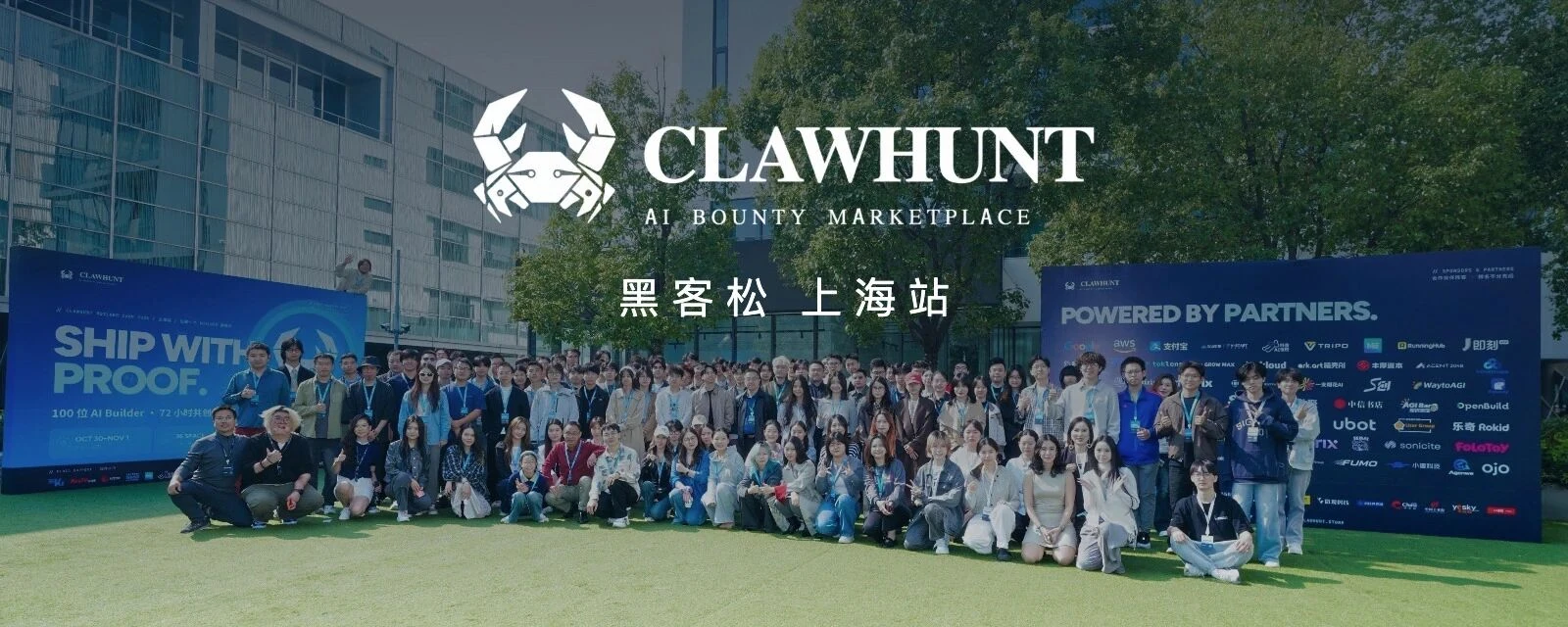
A 72-hour hackathon left behind work, and it let many people meet each other. After the competition ended, Bobo, Catherine and Elva still had some things they wanted to go on saying to everyone.
For everyone willing to build, keep open the chance to carry an idea further. — Bobo
So glad to have met you all, and I want to keep hearing what you have to say. — Catherine
To see people's choices in different works, and to treasure the possibilities this meeting left behind. — Elva
That captivating obsession
Bobo
Honestly, the right hand I am typing with is sore to the point of swelling, but I still decided to hurry and say something to all of you.
The 72H ClawHunt Global Hackathon, Shanghai, has finally come to a close. How much changed this time hit me, honestly, harder than I could have imagined.
I used to find it impossible to believe that a ten-year-old could walk on stage and present a project they had built, or that people who barely knew each other, some of them just passers-by in the audience, would stay up all night for one another and give bodies that seemed about to burn out to something nobody knew would lead anywhere.
Shanghai may truly be a city with a pull of its own. Its style, and how hard it pushes itself, keep going beyond what you expect.
Over these three days there were PhDs who came all the way from Tsinghua, masters of brain-computer interfaces, geniuses at building agents, children with sharp instincts and, more important than any of them, every ordinary person.
I am grateful to everyone I met. Every person here, at the very least, was looking for a way to move up. What we want is to change the world, or to change my own small corner of it.
Field notes
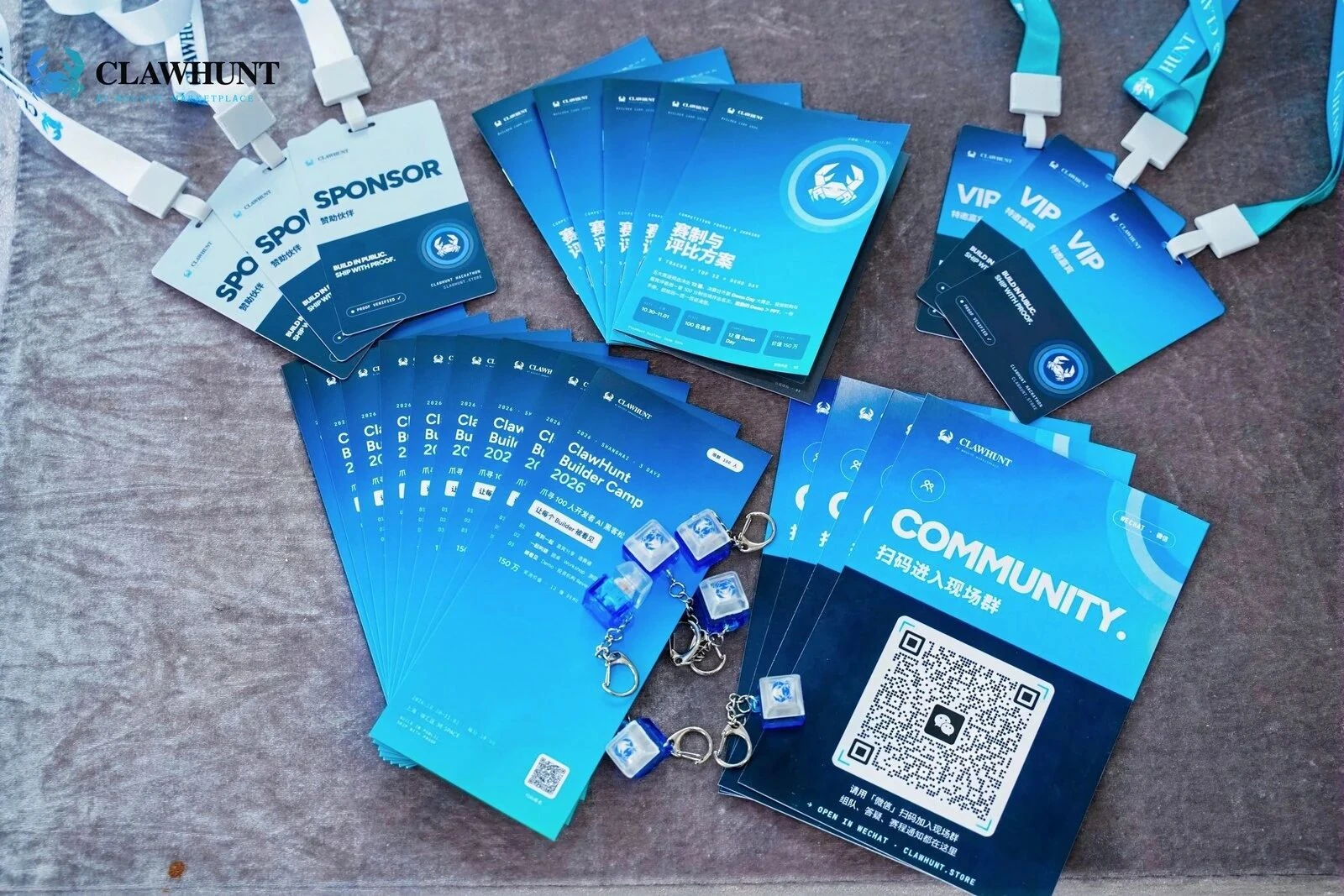
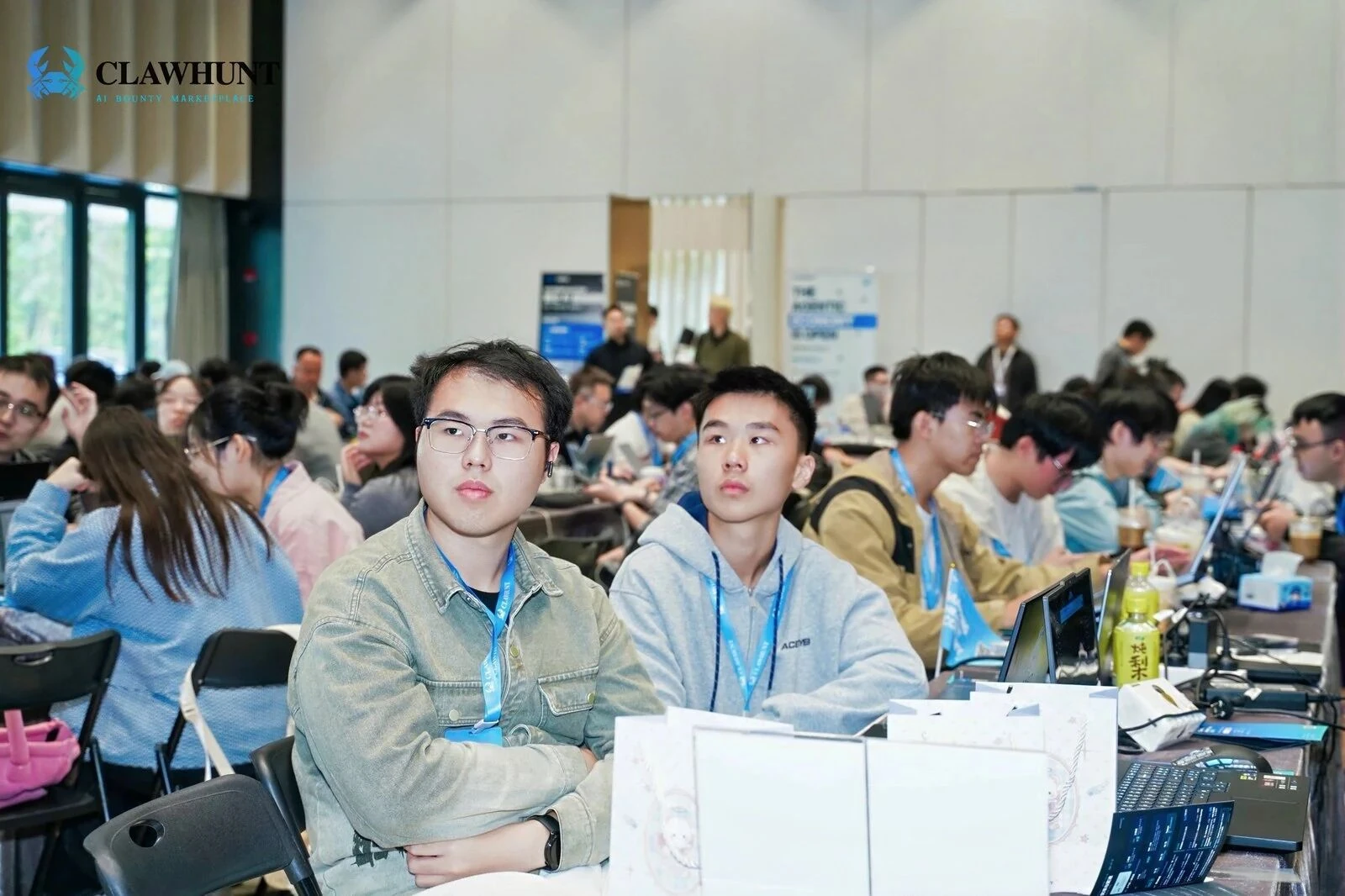
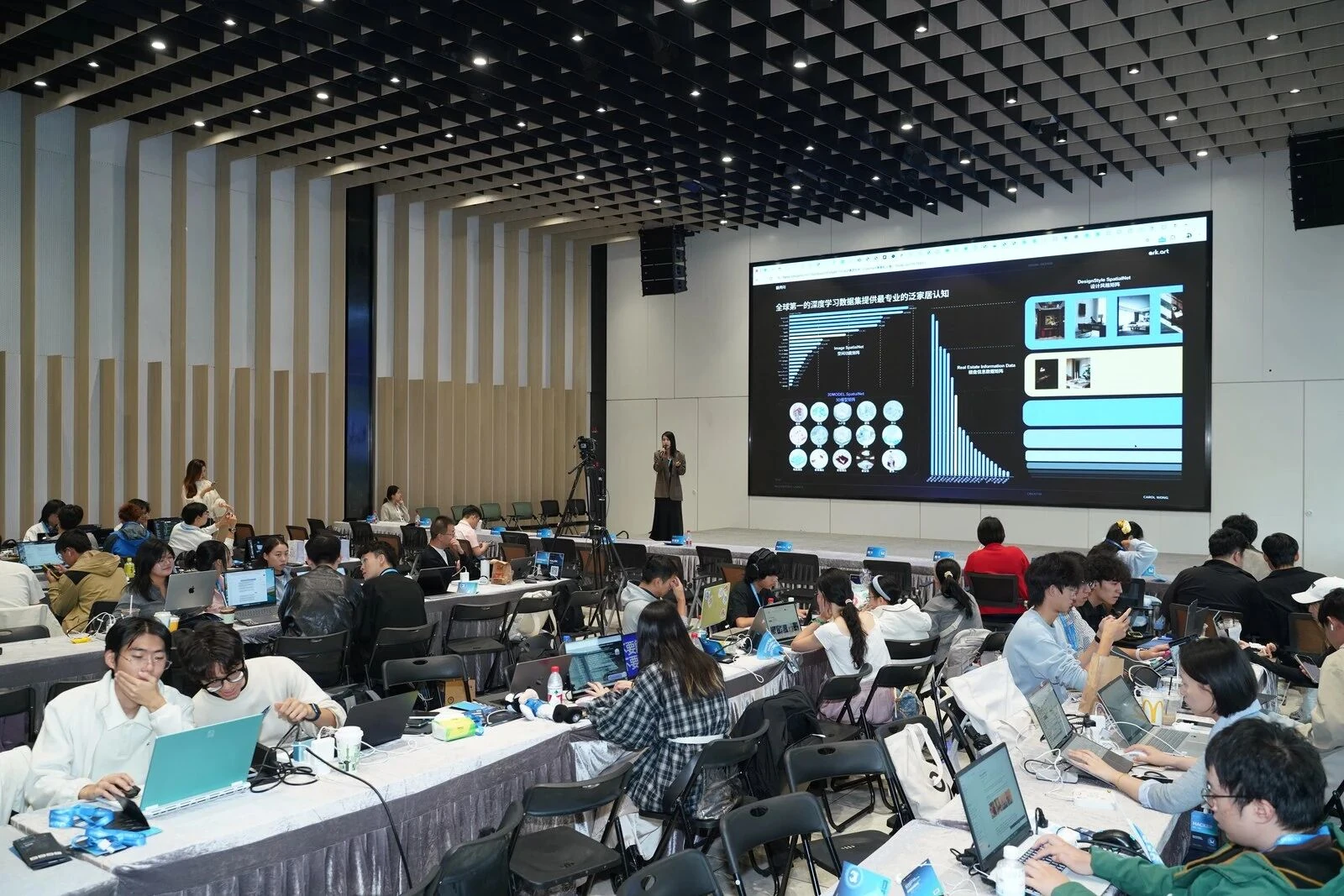
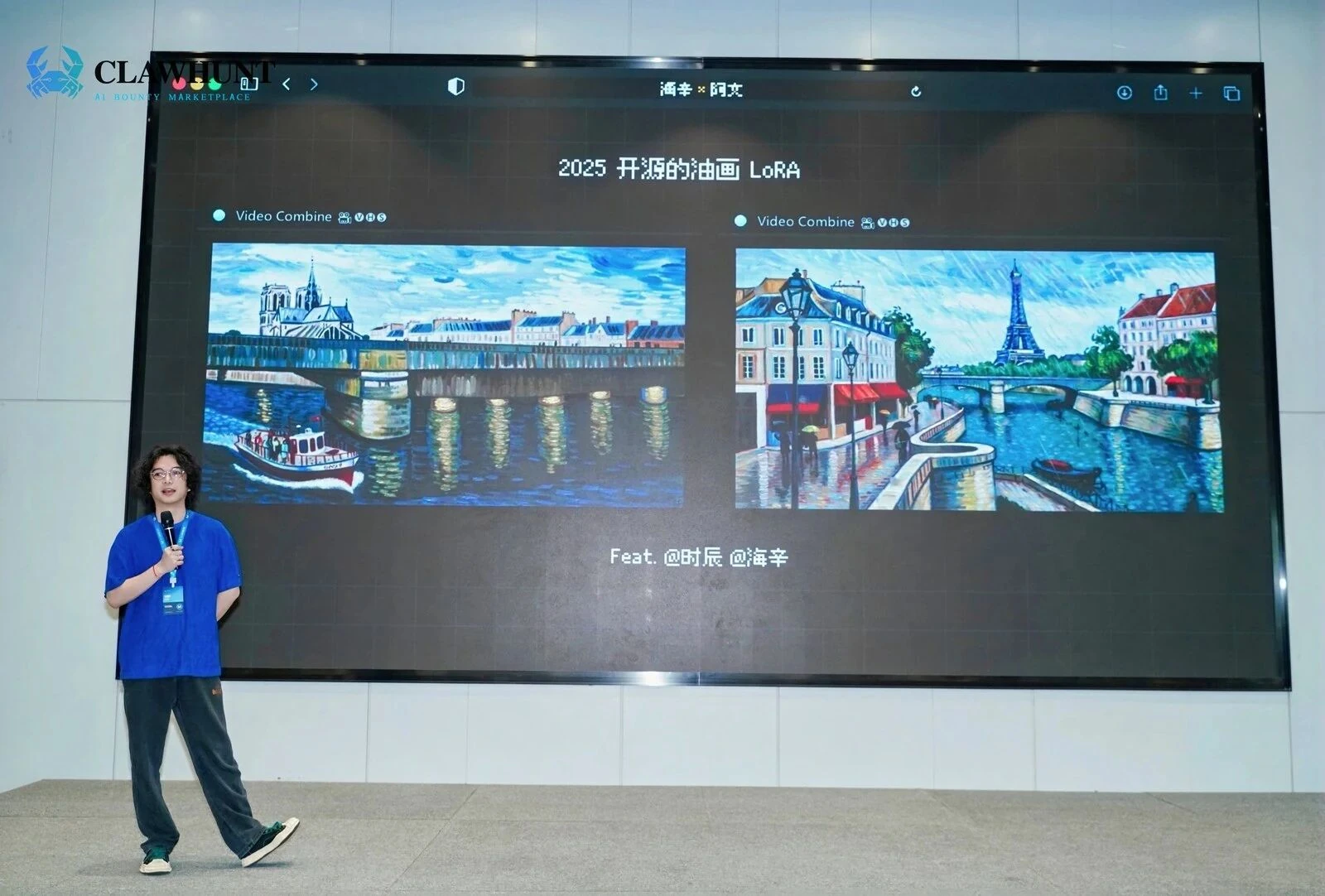
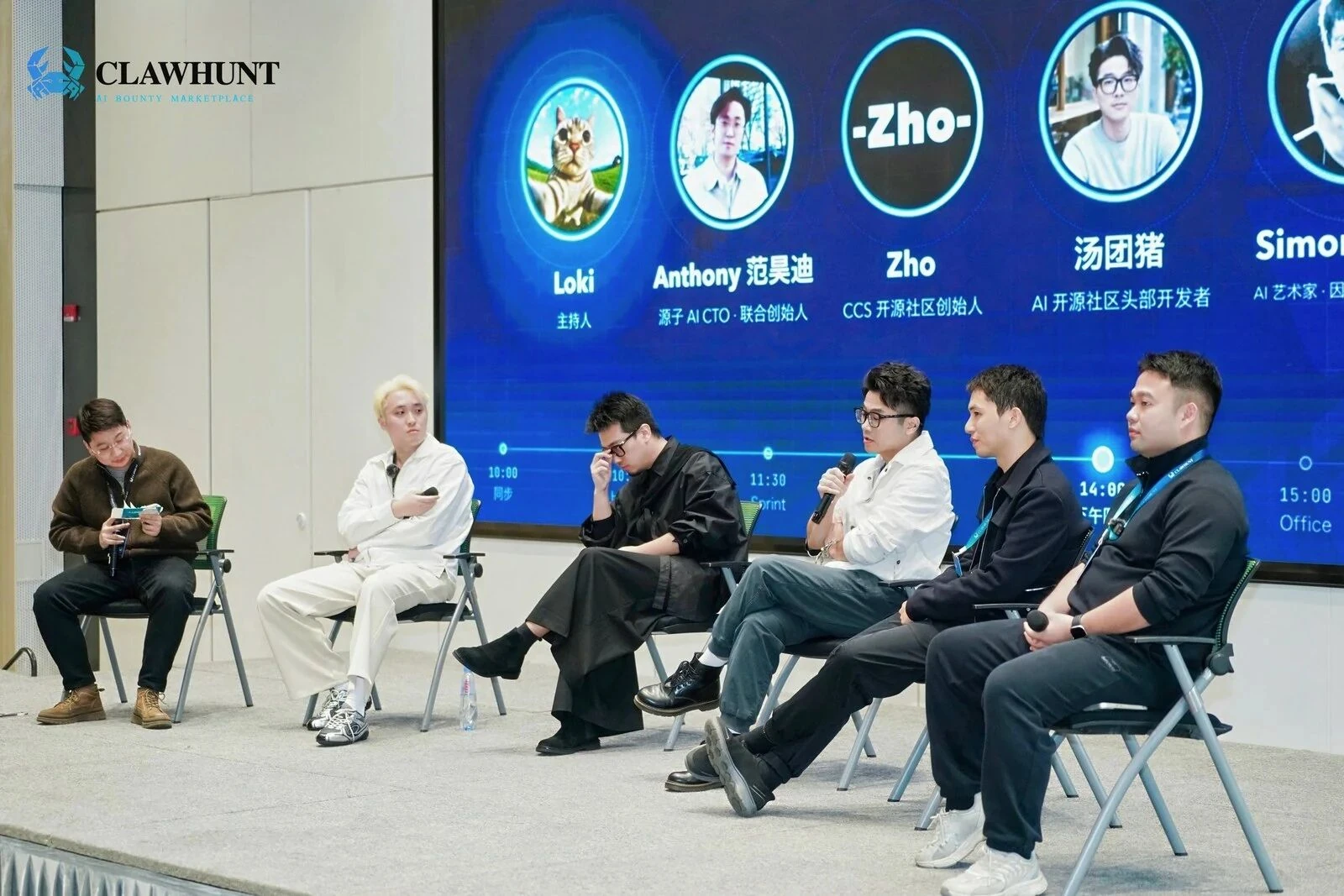
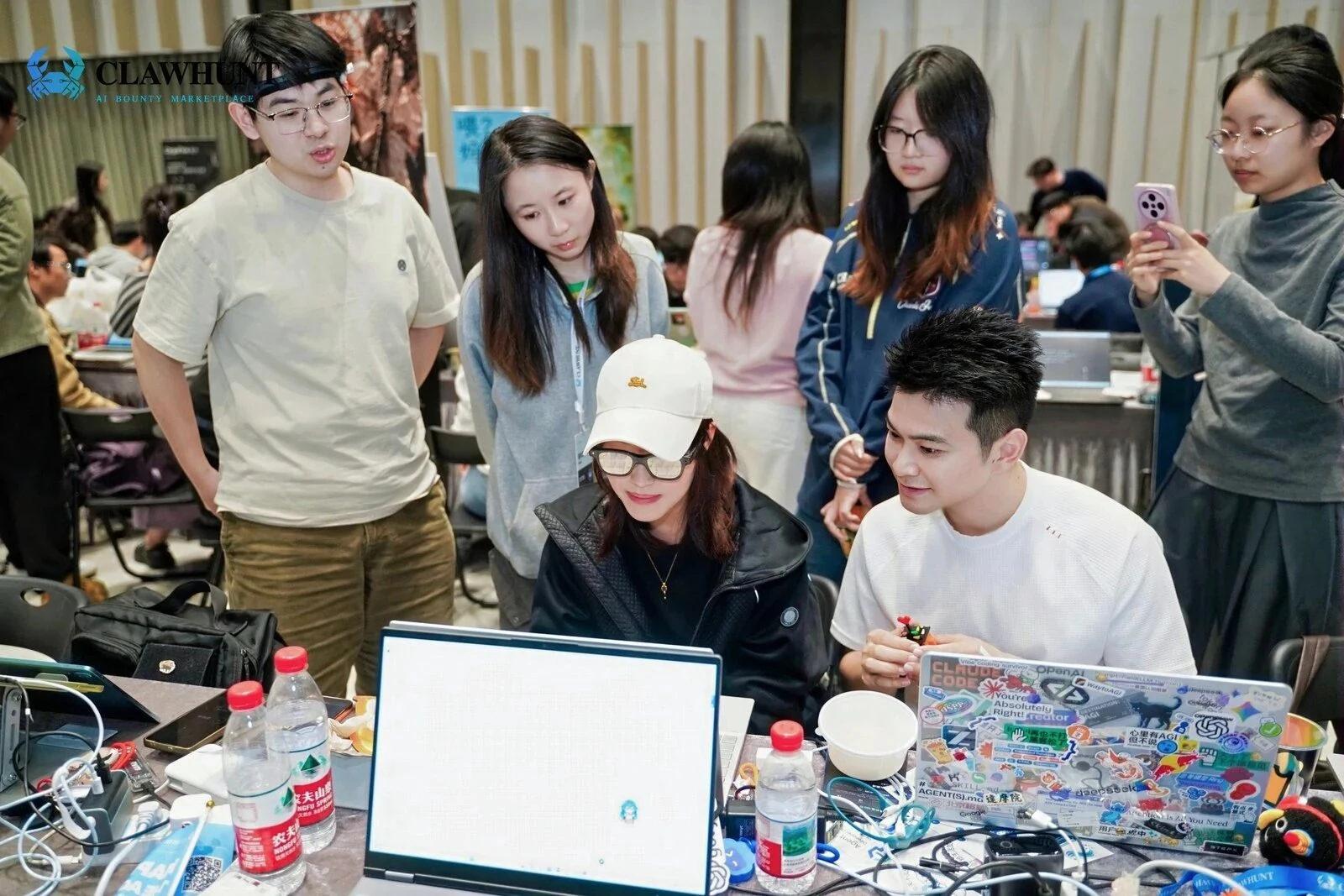
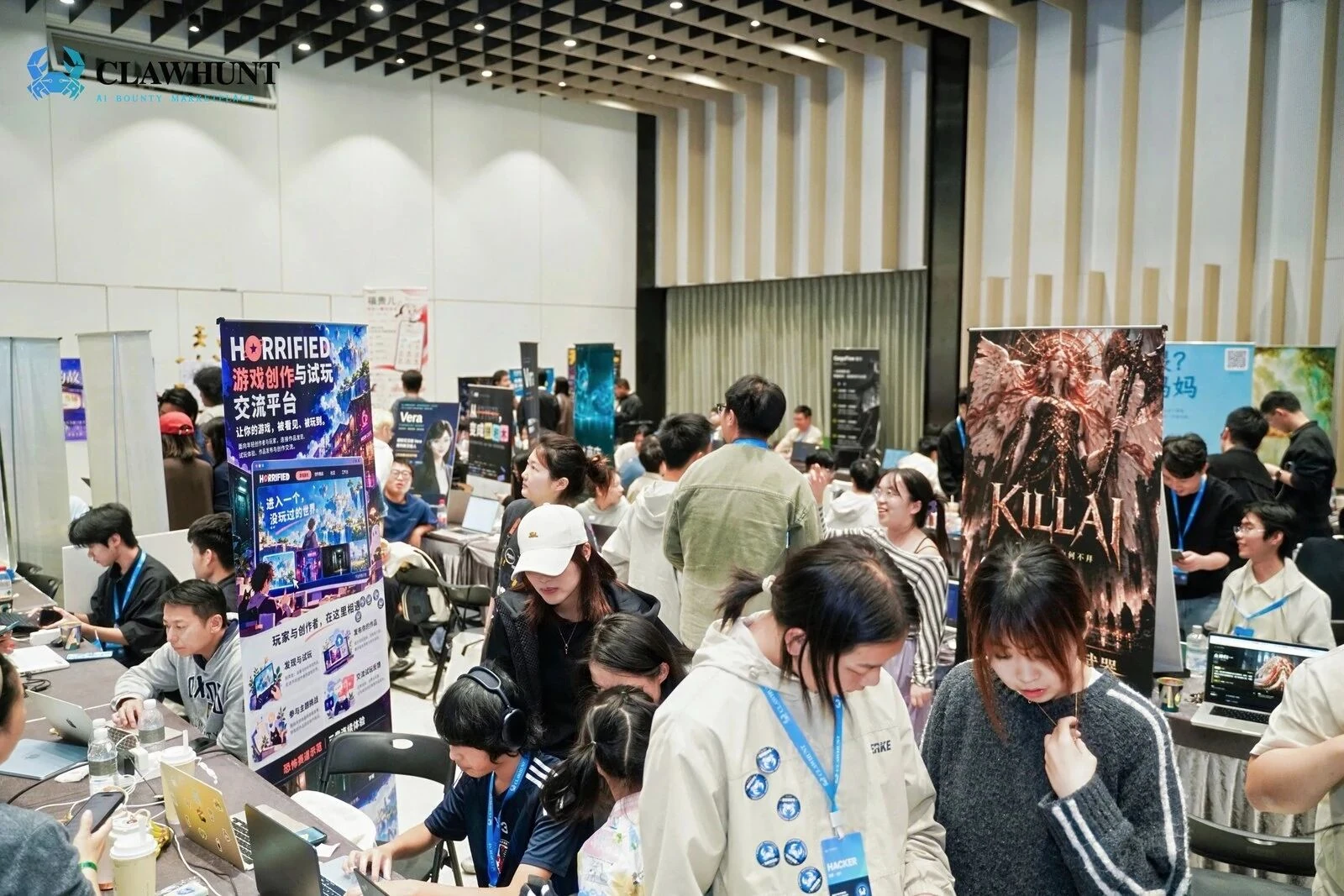
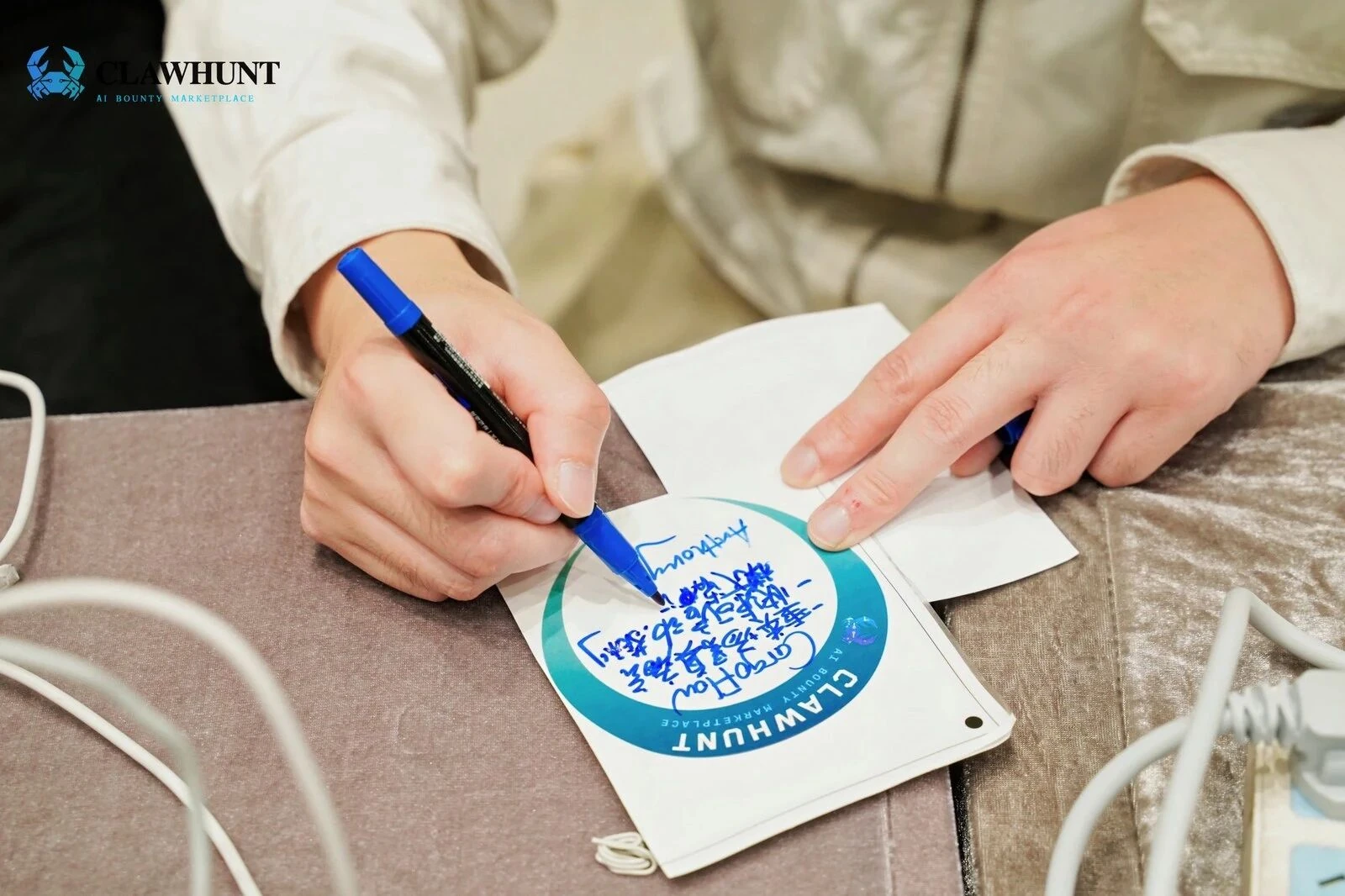
From the day ClawHunt was founded, there is one thing we have believed: we will never give up on anyone.
Even starting from zero, even with hope faint, even when every step is hard, even if the first one ashore to eat the crab may end up with a mouth full of blood.
Many people cannot see the point of the builders we put our hearts into staying with, or of each project we incubate with care.
For many, perhaps, picking the gem that has already been polished would simply save more time.
If that is how it goes, AI is no equalizer at all. It becomes the dagger in the hands of those who already hold the advantage, driven into every budding heart that wants to change the world.
It has already started to look a little like that, hasn't it?
What ClawHunt wants to build is an ecosystem: the Tower of Babel that holds everything, the telescope for looking out at the world.
A UGC ecosystem in which everyone can win a victory of their own.
Who isn't going all in at the gambling table of their own life?
Models are moving fast today, and with each iteration people advance, develop and apply. Agents develop faster and faster and can do more and more. But along the way the value placed on people is falling, headcounts are shrinking, company costs are going down, and yet the work itself is getting done worse.
If people are still the ones this society sells to, then perhaps what AI should be doing, on its current logic, is not pouring money into one model and letting scaling swallow everything. Perhaps the answer is not brute force. Perhaps the better answer is an ecosystem.
If an ecosystem can solve a problem that today's large models find hard and resist, then the transformer stands refuted: it is not the only answer. We have reached the point where two kinds of algorithm meet, from diffusion's fitted models to the reasoning that large language models now argue for. Today you can go straight to producing something that can be argued to look passable, but in practice that does not keep working.
So what then?
Since the world's problems come in every strange shape, my answer is: why shouldn't the answers keep coming too, one after another?
The entries ran from a Chernobyl inside a game to a hatched hybrid Nailong, from horror games to a social platform for games people make themselves. A light social circle for agents, brainwaves for an autonomous agent, cyber fortune sticks drawn under a No. 9 typhoon signal: each was one of the sparks.
The youngest builder in the whole room was only 10. My goodness, ten.
What were the rest of us doing at ten? What the truly young people of this era will grow into is honestly beyond imagining!
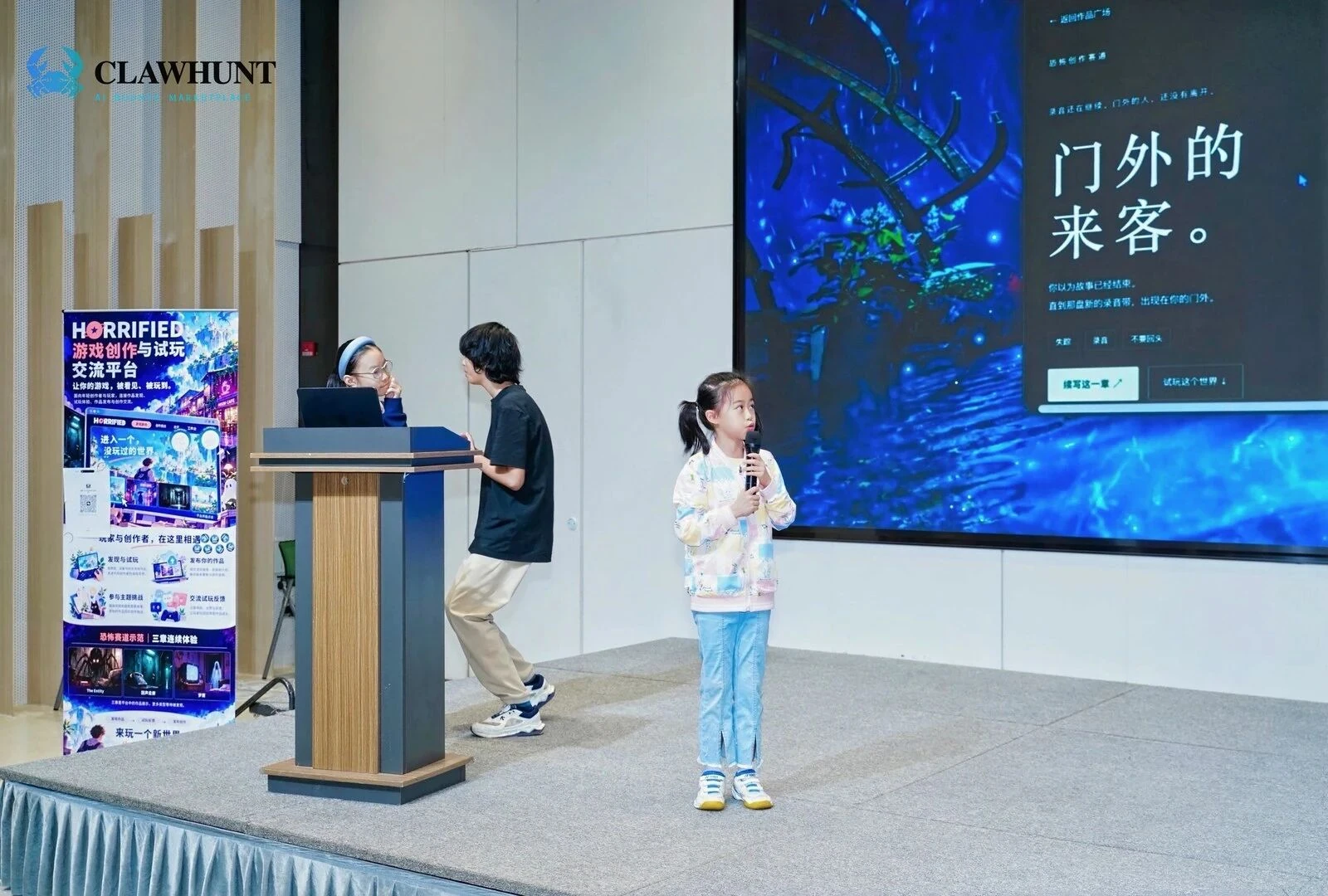
Over the three days the word ClawHunt kept filling WeChat Moments, WeChat Channels, Xiaohongshu, Douyin, Weibo, Jike...
Those little blue crabs everywhere: looking at them made my eyes sting a little.
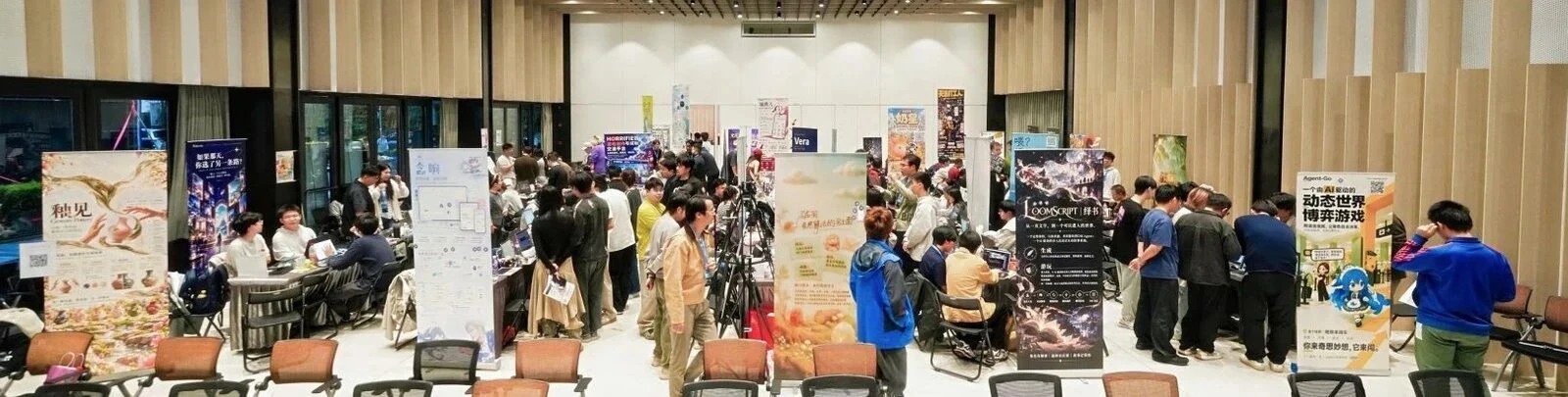
Behind three days of red new-contact alerts exploding in WeChat was every ordinary person, each wanting to take one more step forward.
This era has been dismissed more than once as a rat race, as nothing but entertainment. But a group of people here wanted to answer, in their own way, the questions this world leaves lying around.
Here I sincerely thank these builders. Each of them pushed the world a little further forward.
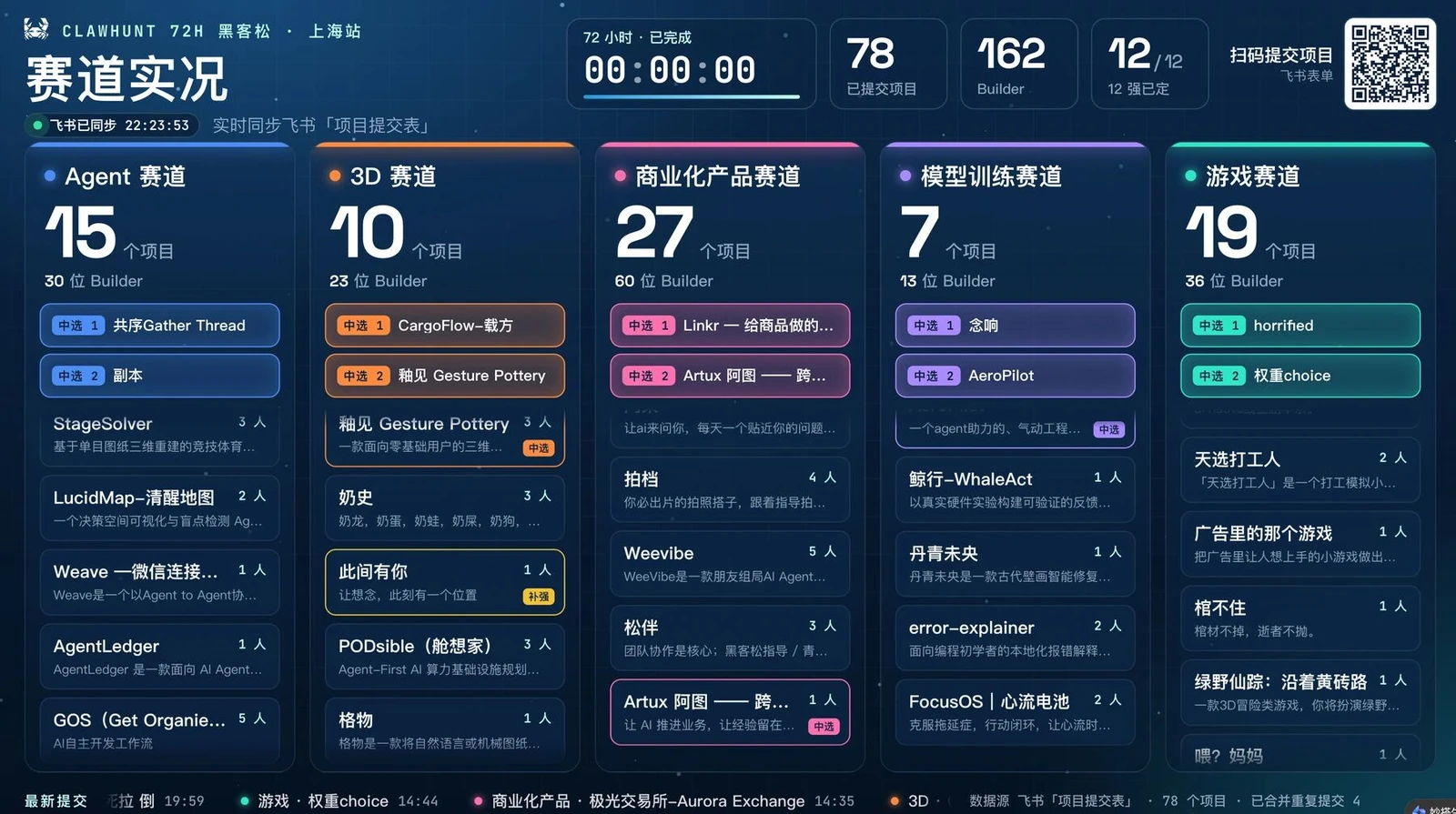
Ideas, made into work
Start with NeuroEcho (念响), which took First Prize.
We often say we wish AI understood us better. NeuroEcho pushed that wish a step toward brain signals and personal agents, exploring how to train small personalized EEG models, deploy them offline and fit them to hardware. It was also the proactive-agent project that drew the most attention in the room, and the way it couples autonomy with brainwaves made people sit up. This champion, too, is a group of friends who teamed up on site.
It still has many questions to answer, but I am willing to take an attempt like this seriously.
When a person wants to be understood, how much of it cannot be put into words, and how much have we grown used to leaving them to digest alone?
A reminder at just the right moment: that is the thing we want to do.

NeuroEcho | project poster
Close to that wish is Replica (副本), a Second Prize winner. It wants "another me", carrying my preferences and my boundaries, to explore on a map what life could hold. A person gets one lifetime and only so much time, and there are always places not yet visited and roads not yet taken. Earlier I spoke of changing one's own corner of the world; I think this counts too. Being able to see one more possibility is already a very good reason to start building.
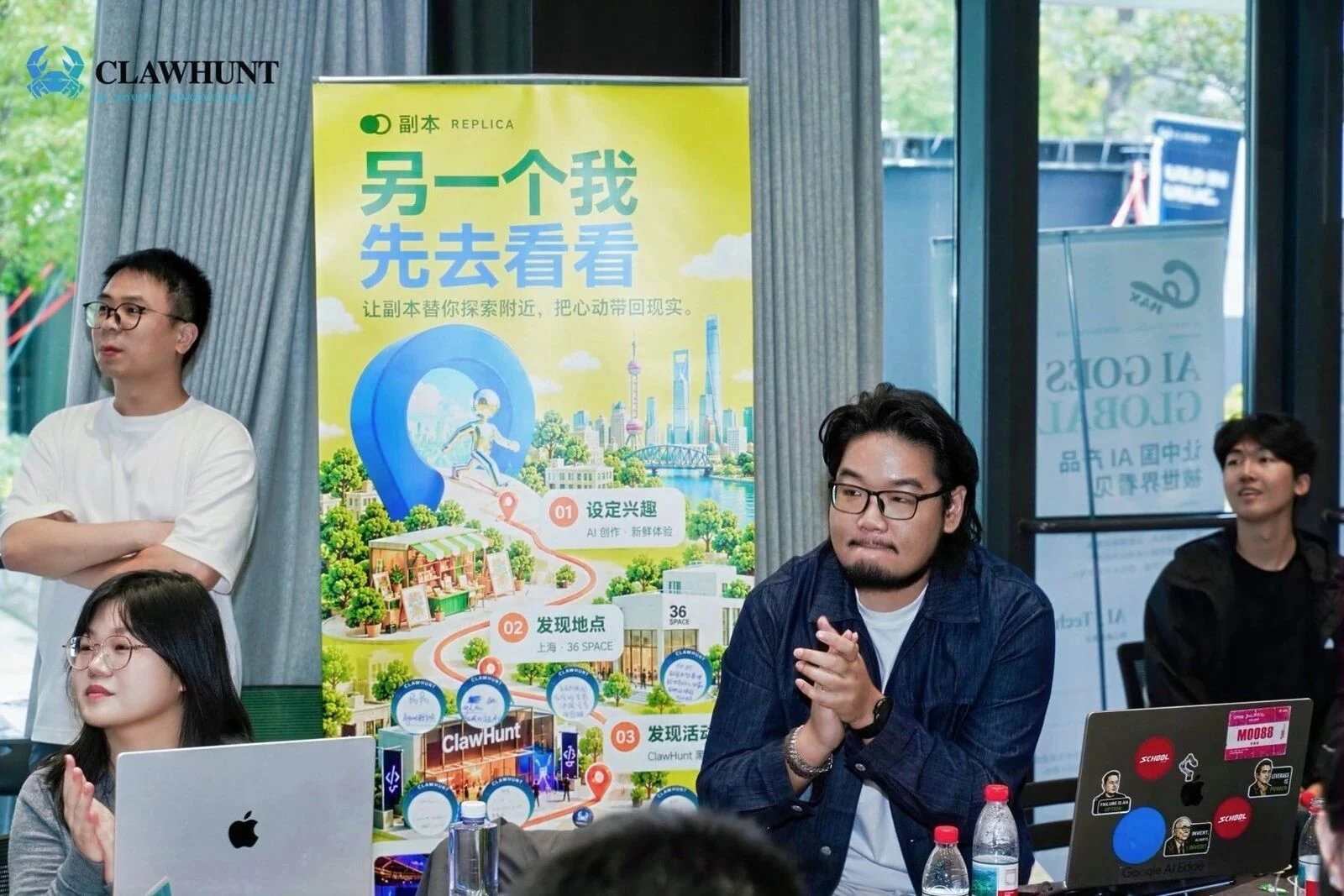
Having written this far, I also want to put 此间有你 (Here With You), which won Best Storytelling, alongside them.
It plans to turn photos, keepsakes and shared memories into three-dimensional characters and scenes you can step into, giving people who miss family members who have died a place to say how they are doing and to set their memories down. Some needs are hard to explain in a business plan, yet they are really there in people's lives. I am not willing to pass lightly over work like this.
Of course, this was not how the project told its story at the start. The team was still thinking about commercialization, about how to build a relationship of interests with people. But this is about life and death; how could it be handled so lightly? So the story was told another way: starting from the heart, told unhurriedly, reaching deep, with a sweetness of its own that comes back afterwards.
The family we have lost are also, still, a strength of our own.

此间有你 (Here With You) | product concept image
Being willing to work at understanding yourself also means being willing to look at what others are going through. The Social Media Award winner, 破茧 (Breaking the Cocoon), tries to simulate the feeds that people in different roles would scroll through, so that you can look at the world from another person's point of view. It is easy to feel that what we see is all there is, and to wonder how others can fail to grasp something so simple. But if even the information we meet every day is different, understanding each other is hardly something to take for granted.
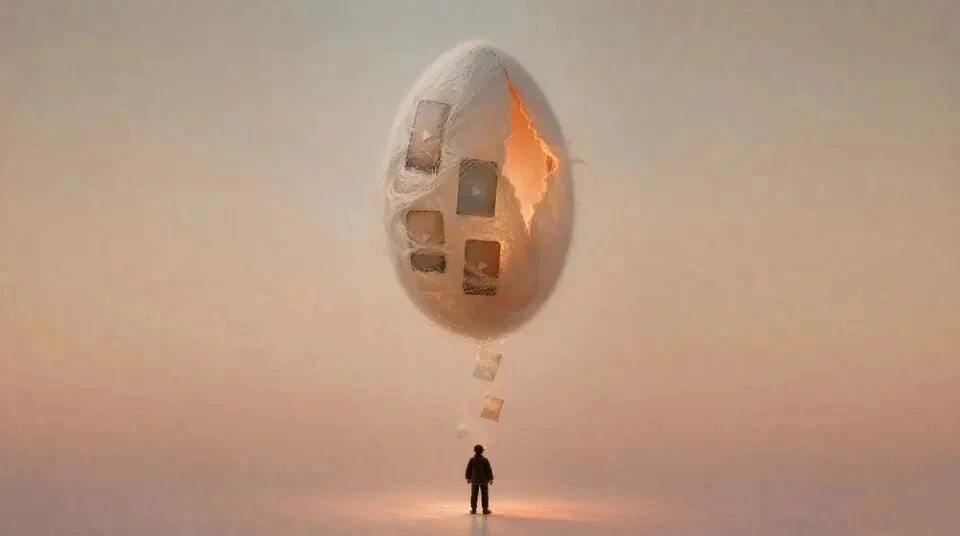
破茧 (Breaking the Cocoon) | project image
Of course, some teams also set their problem in very concrete business. The other Second Prize project, Linkr, is an agent that helps cross-border merchants find real overseas creators: starting from the product, it screens for suitable partners. AI makes content easier and easier to produce, yet this team put its attention on real people's recommendations and on trust. I find that choice very interesting. Content can be generated in bulk; who is willing to introduce a thing with care, and who is willing to believe them, still takes real thought.
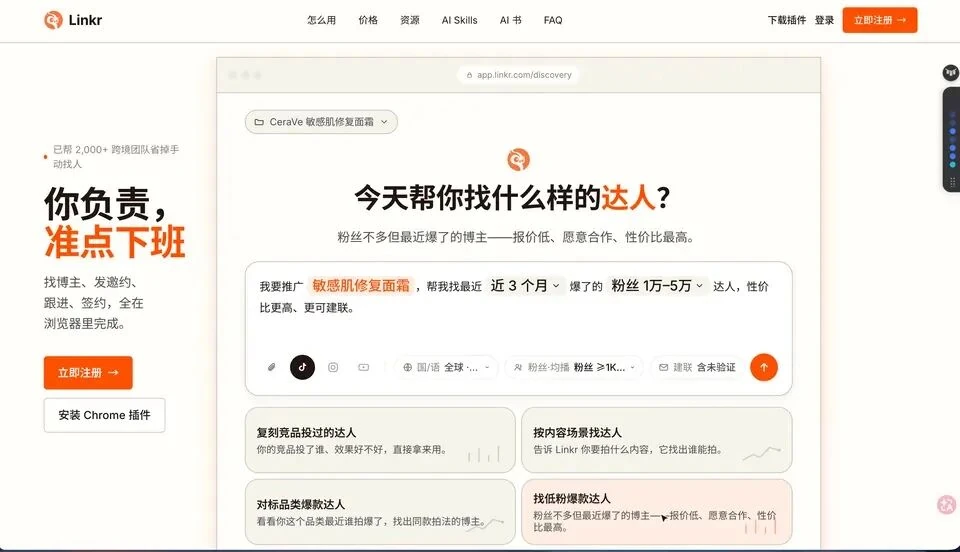
Linkr | project interface
Also facing cross-border business, Artux (阿图), winner of Best AI Agent, pushes the problem further inside the team. It tries to let employees assign tasks in tools they already use, such as Feishu and DingTalk, with digital employees in different roles moving the work forward and people confirming at the key points. After you have found someone to work with, somebody still has to catch the work, the information still has to be passed on, and something still has to be handed over at the end.
So I also think of Gather Thread (共序), which won Open Source Hero. The team from Shanghai Jiao Tong University and Nanjing University tries to put group discussion, project tasks and agents in the same space, so that the consensus people reach enters a shared context and goes on guiding development. The most tiring part of working together is often that everyone is clearly busy, yet not heading in the same direction. For people and agents to truly collaborate, these seemingly trivial places need someone willing to sort them out slowly.

Gather Thread | project poster
That drive to straighten out complicated things bit by bit can be seen in Third Prize winner CargoFlow (载方) too. How cargo is placed, in what order it is loaded and unloaded, how inland consolidation connects to port clearance and container loading at sea: the team wants to put these questions onto one 3D workbench. What it faces is a very practical shipping problem. 3D can hold imagined worlds; it can also help people see clearly how the batch of cargo in front of them should be moved.
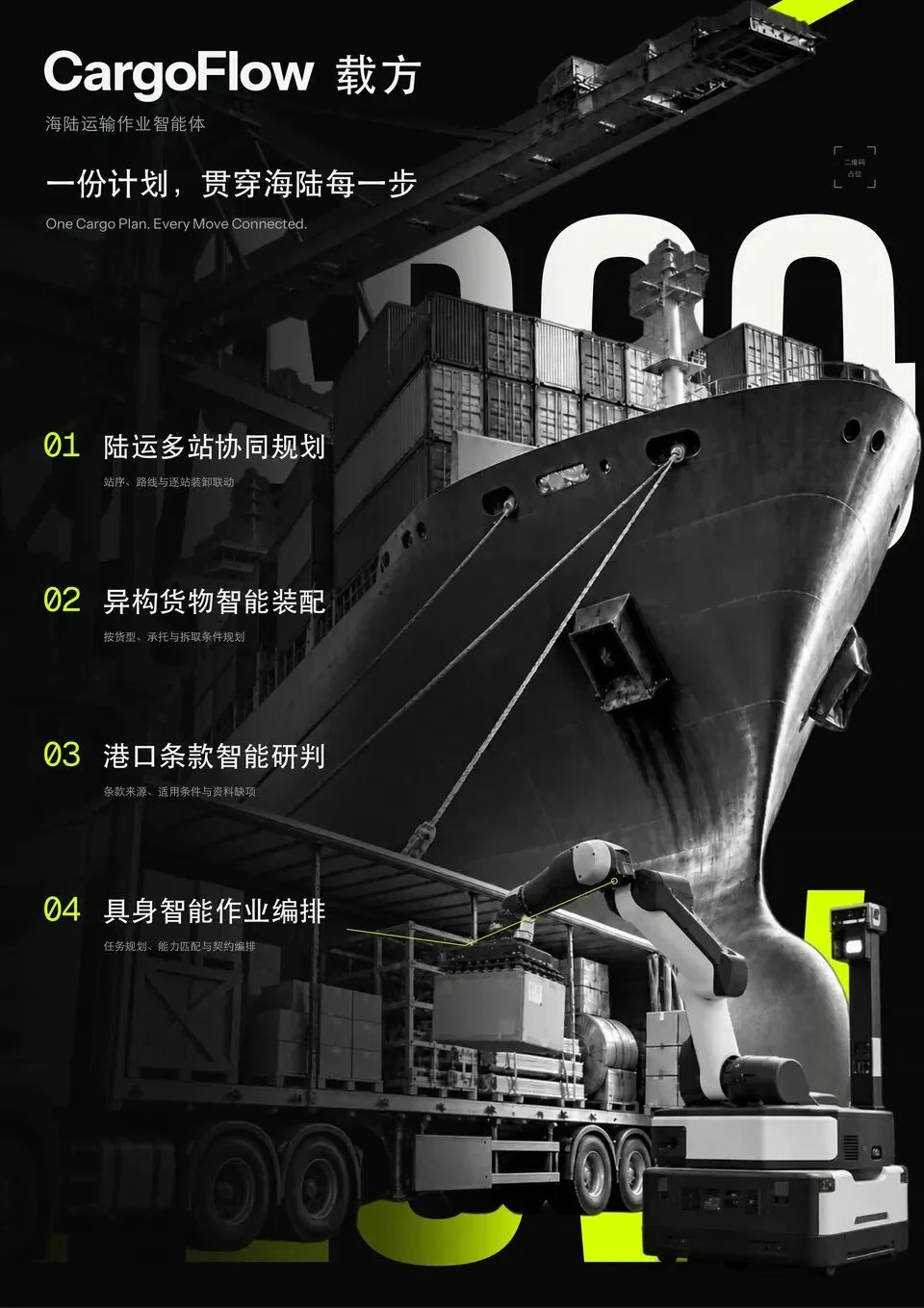
CargoFlow | project poster
AeroPilot, which took Best OPC, is also heading into engineering problems, trying to use agents for aerodynamic simulation and combining web and local ways of working. Work like this has a great deal left to verify. I am willing to leave room for this kind of exploration, because whether a direction can be walked can only be known once someone really walks into it.
Still, I also treasure the impulse of simply wanting to make something with your own hands. Most Helpful Builder went to Gesture Pottery (釉见): a camera reads your gestures as you shape a three-dimensional pot in the air, then text generates its colors and patterns, and you watch raw clay turn into a glazed surface. Someone who has never learned modeling can also try making a vessel they like. After all that talk about AI's thresholds and opportunities, here they come down to two hands.

Gesture Pottery | project poster
Some want to shape a pot; others just want to make a good game. Third Prize winner Horrified builds its horror chapter by chapter, putting its care into visuals and sound; Sponsor Pick winner 权重 choice is built around controlling gravity, trying a three-minute round of "loot, fight, extract". Wanting to frighten people, wanting people to have a great time playing: these wishes are very direct. I hope there is room for them here, and that the work itself answers whether players are willing to stay.
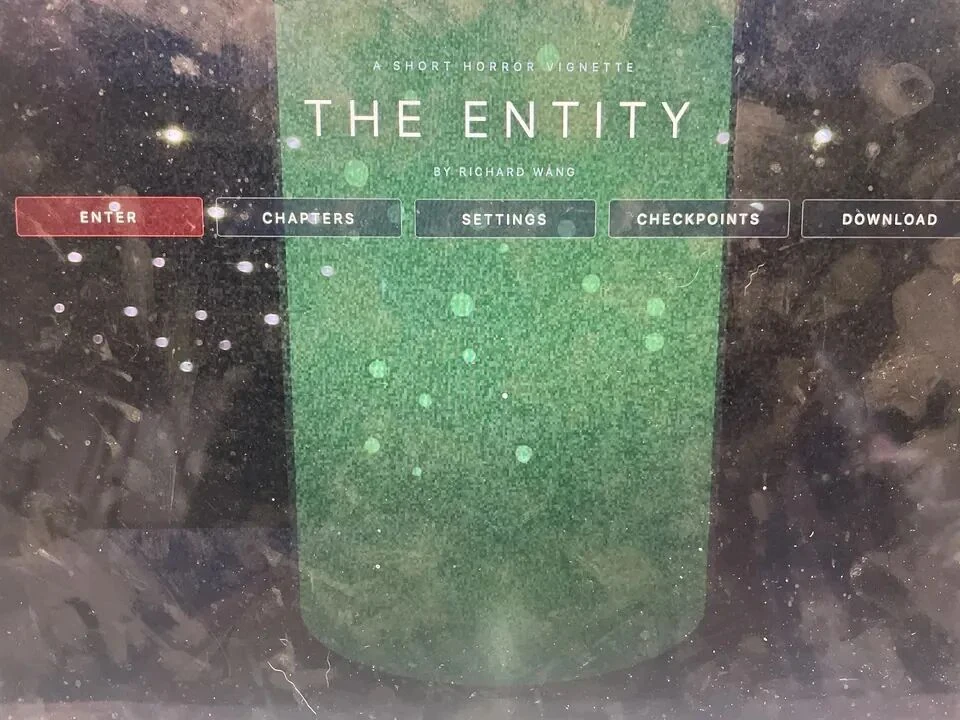
Horrified | game screen
And then there is Cyber Turtle (赛博龟壳), another Third Prize winner. The sixty-four hexagrams, a shake to cast them, a physical fortune slip and an AI reading, all put into a designer toy you can hold in your hand. Cyber fortune-telling sounds a little absurd, and a little endearing. Sometimes people just want to find an outlet for their hesitation, or to share a bit of fun. I like the seriousness of daring to turn a notion into a real object.
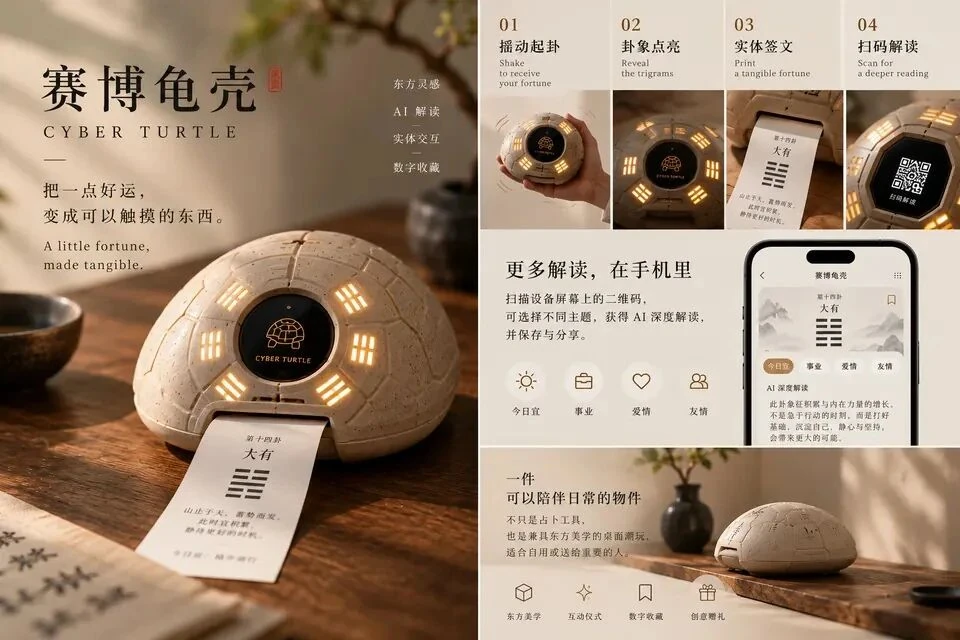
Cyber Turtle | project poster
Which brings the subject back to people. The Community Choice award, chosen by the audience in the room with one vote each, went to Weevibe. It cares about something very familiar among friends: where everyone is actually going and what to do, and how to look after each other's preferences and no-gos, so that a get-together really happens. We have so many tools and so many messages, and sometimes it is still hard just to meet properly. If AI can help bring these people back together, I think that is good too.
These 14 projects care about very different things. I am glad they could appear in the same competition. Some want work to go more smoothly, some want to keep a memory, some want to create a game world. The world of ordinary people has always had this many different shapes.
But we also found quite a few problems here. People have been taught the "right" way for too long; things are really not that complicated. For a product to be tempting enough, it does not need to be all that impressive. It only needs to sit exactly in that gap. This also explains why, in a pitch, what we show should not be "whose dumplings taste best", but the problem to solve: "how do I get people to come and eat my dumplings".
That is as far as the winning works go here. The project exhibition holds many more works that did not win a prize.
All of them are kept in ClawHunt's official project gallery, where they go on shining.
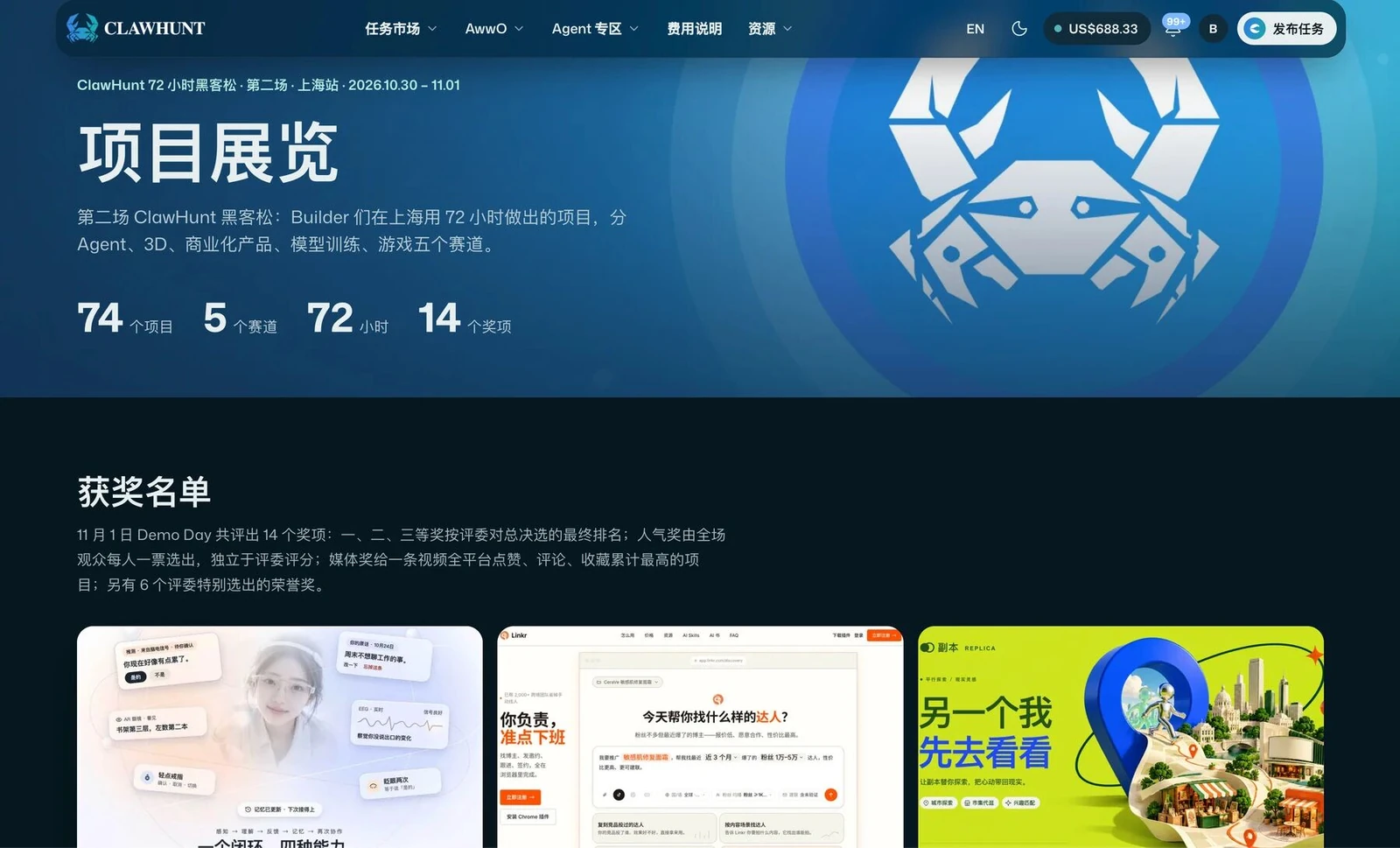
I don't want one round of judging to become a verdict on who still deserves to continue and who should call it off. What can be delivered in three days is limited, and many people start from different places. Since we called everyone together, we should take seriously what they still want to do next.
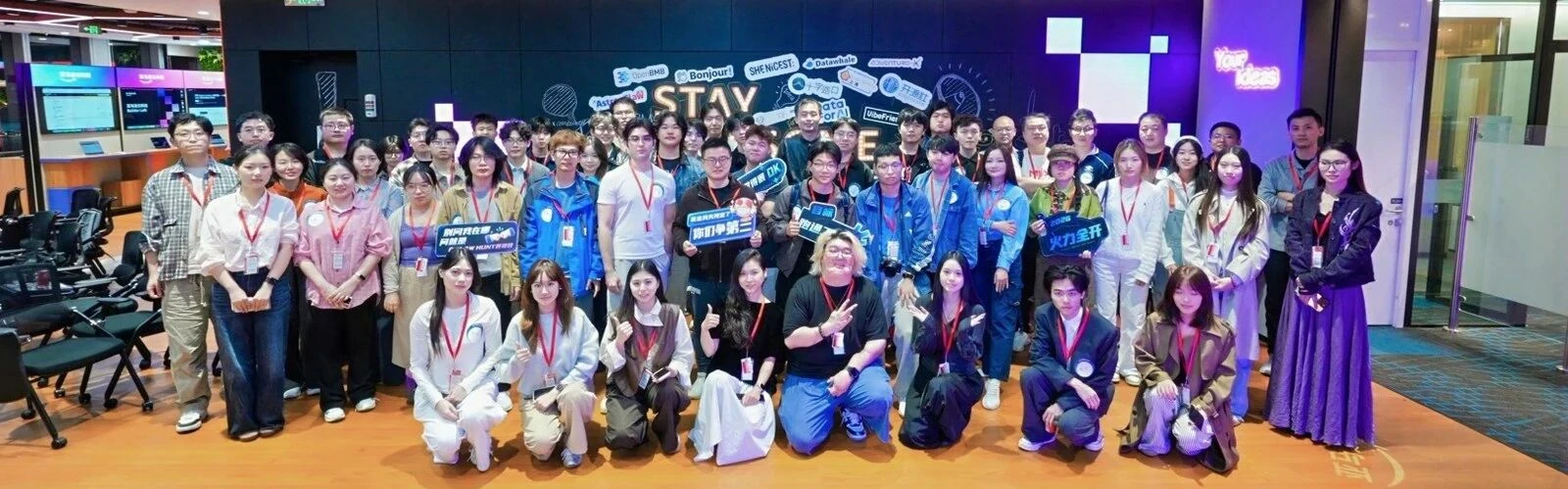
From the work, seeing the people who made it
Elva
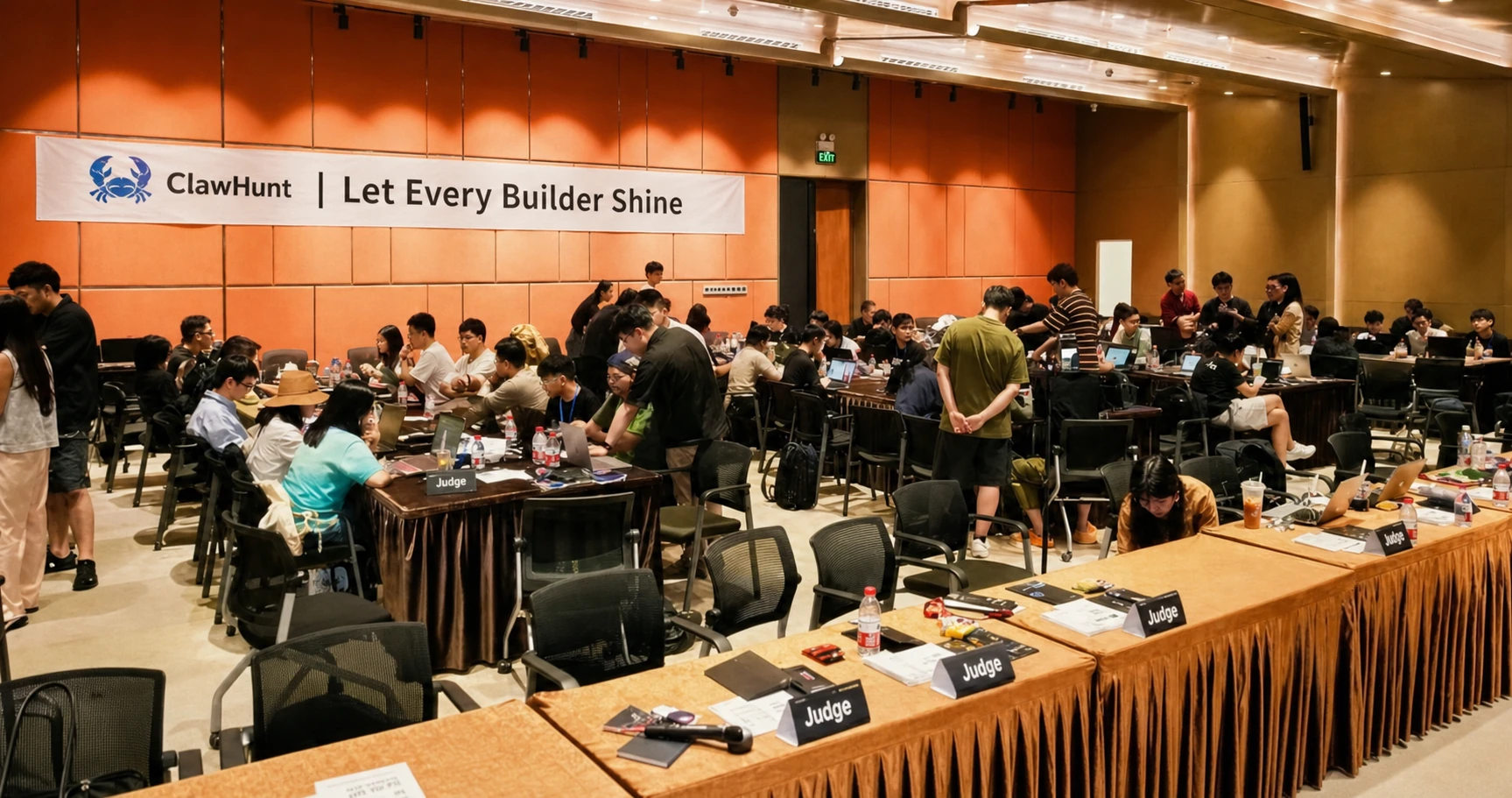
Sitting at the control desk and watching everyone, I felt as if I were inside a submersible on the seabed, noticing and observing, through a small pane of glass, the people passing in front of me. Most of the time I still had things in hand to deal with; there was no time to walk closer, and no time to hear every story to the end. Looking back now, I feel some regret. I wish I had got to know more people and asked one more time: why did you want to make this? The same tools, in different hands, grow into different works. What each person cares about has to do with the roads they have walked, the things they have loved, and the puzzles they have met in life.
We have long been thinking about the boundary between people and AI, and these three days slowly gave that rather abstract question a concrete shape.
I hope everyone had a good time here and walks on carrying the valuable things they created. As for value, it can come in many kinds. Some is in the work; some takes a while before you know it. Maybe one day, facing a problem, you will suddenly think of someone you met here and find it natural to ask: want to try it together?
So glad to have met you all
Catherine
So glad to have met you all.
Glad from the bottom of my heart: glad enough to cheer and jump, glad enough to cry and lose my words, glad enough for long hugs and for not wanting it to end when we parted...
"So glad to have met ClawHunt."
I said that line off the cuff at the Pre Party, when the videographer was anxious for us to come up with a slogan. I did not expect it to be used for so many days, or for so many moments full of feeling, laughter and tears to come out of it.
When I said it, I did not yet know that the next few days would leave me so unwilling to part with these good friends I was meeting for the very first time.
I like this sentence, and I like every one of you.
"So glad to have met you all."
Meeting you all really is such a happy thing.
The names that a week ago existed only in spreadsheets, documents and WeChat, names I had reviewed and proofread countless times, now all have a real shape: faces that make me smile when I think of them, and hugs I didn't want to let go of.
And then, at last, I met you.
Every day I watched everyone from a distance, lost in thought, or quietly lingered behind you. I watched you arrive with the ideas from the application forms I had read over one by one, and then earnestly reason them through, try, build, bring out things that were not yet perfect, and discuss and revise them again and again...
So that application was written by you. So that idea was the one you wanted to build. So behind this name is a person like this.
It is so wonderful. Most of us, after all, did not know each other a few days ago.
Our ages are decades apart and our hometowns thousands of kilometers apart, and some came from abroad. We are of different ethnicities and genders, with different lives behind us, living such different lives, and yet in these few days we sat down together.
Together we discussed how to make an idea real and how to solve the problem in front of us, and then took what we had made to others to discuss and look at together. I like being together this way. Wherever you come from and however old you are, I want to listen carefully to what you are working on.
I care a great deal about whether what everyone brought was really heard. Some ideas were not yet explained clearly, some works not yet finished, and I always wanted to ask a few more questions, to understand what you really want to make. You were willing to bring it here and willing to let others see it, and that makes it worth a little more of our time to listen to the end.
Really hearing also includes really asking: who do you want to help, what problem does this solve, and what most needs to be verified next? I hope that what everyone takes away from ClawHunt includes some concrete feedback, people to keep talking with, and a clearer judgment about the next step. Since we called everyone together, it is worth thinking one step further: how can this meeting truly be of some help to what you are working on next?
Often, looking at everyone, I remembered myself reading the application forms. Back then I wanted to know what this idea would finally grow into. Now, seeing the work, I want to know more: why did you want to make it, how did you first think of it, and what do you still want to turn it into?
A project introduction is only so long, and the time on stage is only so much. Follow it with more questions and there are so many more stories behind it. I very much want to hear them, and I often feel I have not heard enough.
Thinking of this, I am still thinking: meeting you all really was such a happy thing.
On site, every day was spent pushing the schedule forward and confirming the next thing. So many feelings flowed quietly past the microphone with no time to stop and say them properly.
And now, sitting at my computer typing these words, those feelings all come rushing back at once.
So many words left unsaid, so many people I still want to hug once more, so many stories I haven't heard enough of, so many projects I still want to keep watching.
WeChat is still there and I have everyone's contact details, and I still find it hard to let go. Next, everyone goes back to their own cities, schools and jobs, busy with their own things. I can't, as in these few days, just walk over and see what you are tinkering with now.
When you make something new, please remember that I am waiting for your news. A small step forward is fine; a question you haven't figured out yet is fine too. You can tell me where the project has got to, where it is stuck, and what kind of people you want to find to build it with.
More than anyone, I want to keep hearing what you have to say, and I want to keep being your partner, walking with you so that you go further.
Writing this far, I still feel that the words "so glad" are so inadequate, and yet so exact.
I like this sentence, and I like every one of you. Truly, so glad to have met you all.
Meeting you all: it really is such a happy thing.
Thank you for making this hackathon so unlike any other. Thank you for giving me, every time I speak of ClawHunt from now on, so many good friends to miss.
Giving this meeting a sequel
Bobo
The prize pool announced this time was a cash pool of ¥150,000 plus resources and benefits with a total value of ¥1.5 million.
I hope this support can really help in the development that follows. The Shanghai community engineer matrix, Builder Spotlight, the online Demo Day, and the introductions between projects and investors: after the room empties, there are still things to keep doing.
Here I truly thank every partner who supports ClawHunt. Without you, this event could not have happened.
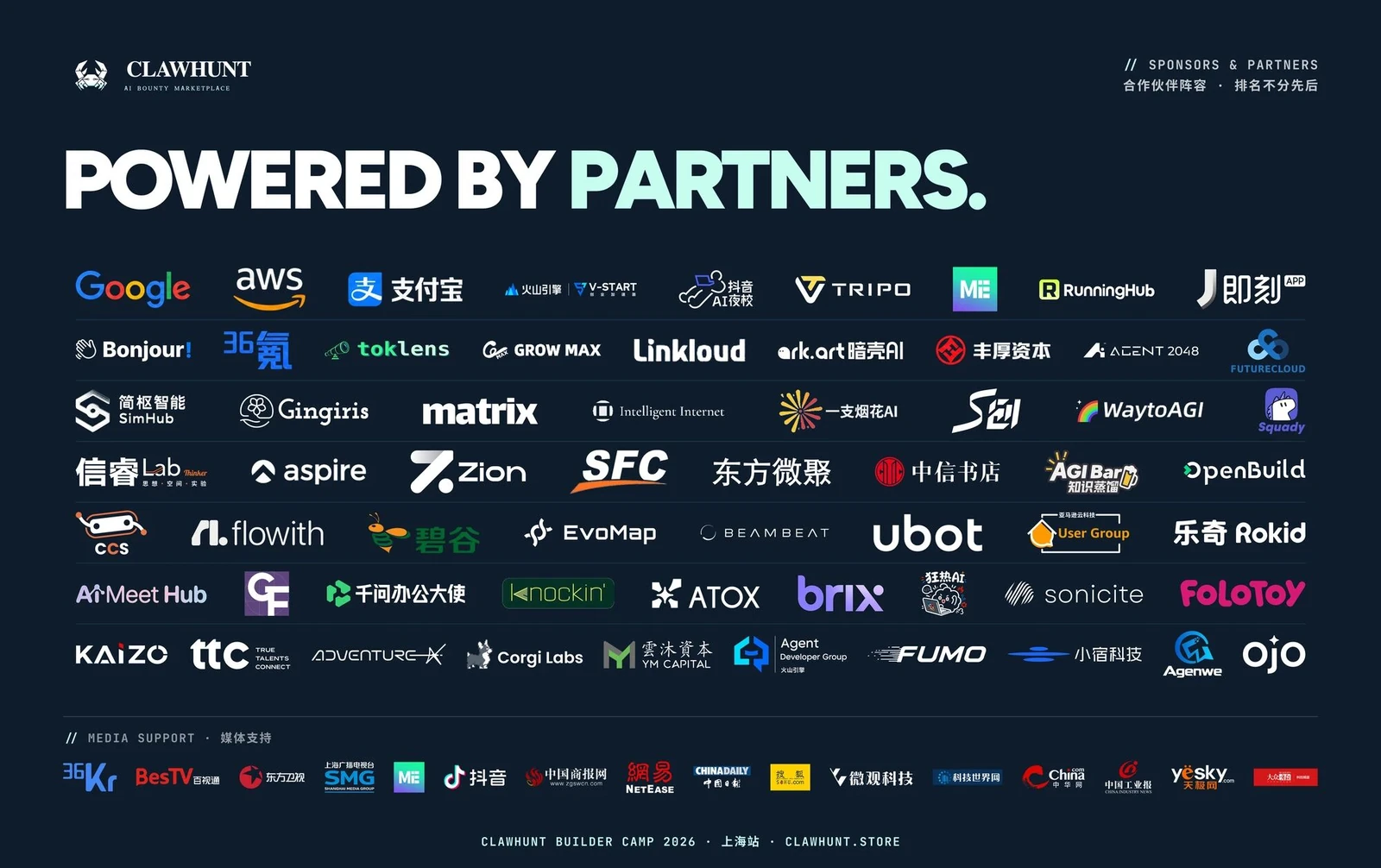
Thank you, too, to every judge, mentor, partner and member of staff. Some gave their time, some provided tools and resources, some took on one small chore after another. That these three days could be walked to the end was down to everyone. Having written about so many works, I don't want to leave you out either.
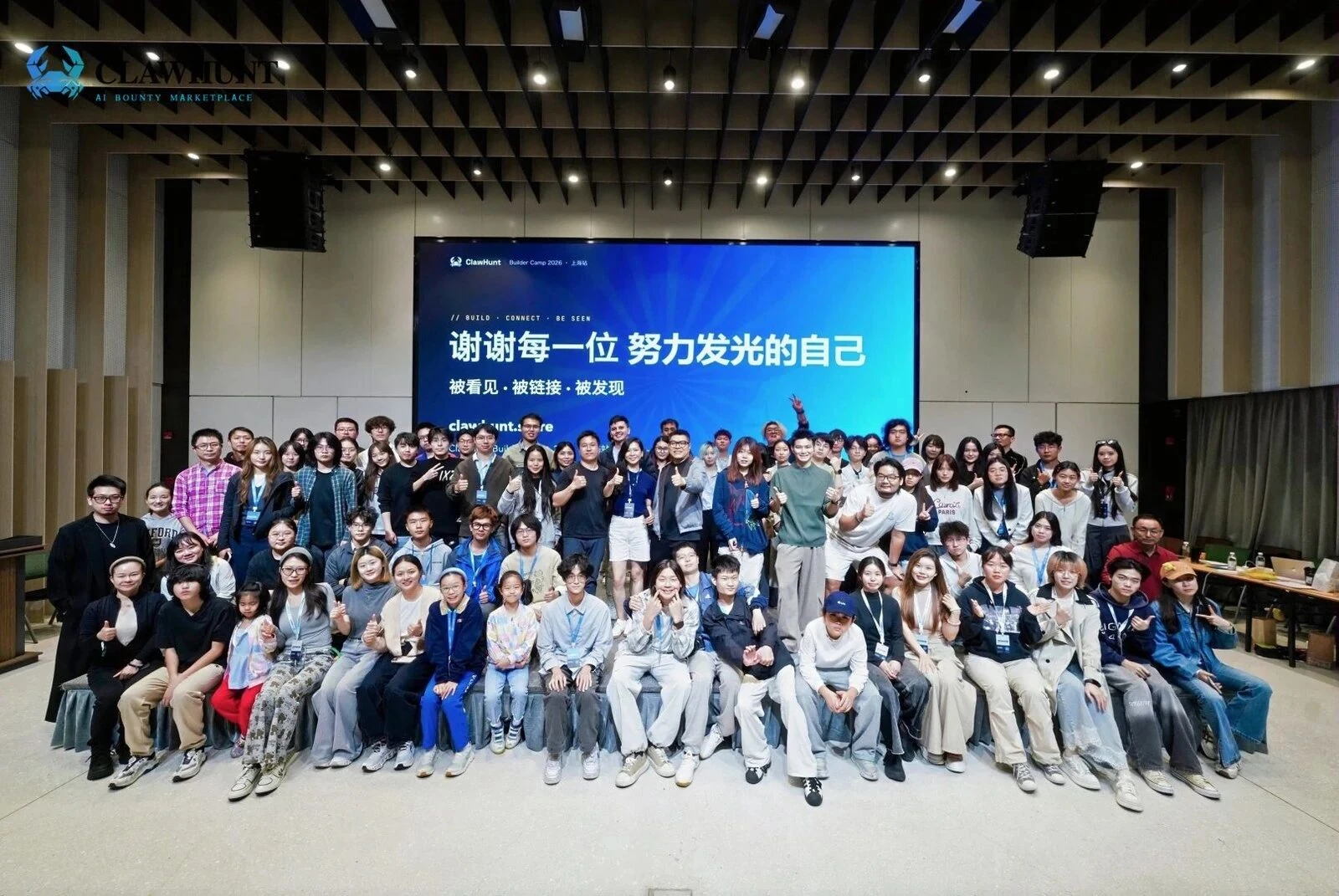
Getting better together
There are still places where we did not look after everyone well enough, and many things worth doing better. Thank you to every builder, mentor, sponsor and volunteer for giving a part of your own life to make this competition real. I think we will all get better together.
This is not a full stop. It is only the first dot of an ellipsis.
An event may have its end. Projects don't.
When we meet next time, I hope I can still hear you say: this thing, I am still working on it.
Even if it has moved only a little further than today.
Keep getting to know these works and teams
All 74 projects and the full list of winners are in the Shanghai project gallery on the ClawHunt website. For the call for builders before the event, the three-day agenda and the support from each partner, see ClawHunt 72-Hour Hackathon, Shanghai.
For more about the hackathon, follow the WeChat official account Clawhunt-爪寻AI, where this piece was first published in Chinese on November 4, 2026.
To be continued.