Bo · ClawHunt · August 10, 2026, 17:30 · Guangdong
This is Article 1 of 10 in the Graph Engineering series.
It belongs to our series of AI engineering guides aimed at practitioners shipping agents in production.
Around July 18, 2026, nothing that could reasonably be called a launch happened in AI Agents. There was no new model, no major framework release, and no new protocol.
Yet from those two days onward, the English-language technical community began using one term for something it had already been doing for more than two years: Graph Engineering.
A note on source quality: secondary sources variously date the post that ignited the discussion to July 17 or July 18. The original X post could not be retrieved during this research, so this article uses the July 18–19 window. The July 18–20 timeline and every quoted statement from X are cited second-hand from AI Builder Club’s Graph Engineering Guide (2026). I found no independent primary archive, so they should all be treated as secondary material. The only primary source on the timeline whose wording can be checked line by line is the official LangChain blog post dated July 22, 2026.
This pattern is not new in software. Monoliths had been split for years before the term “microservices” appeared. Operations and development were already arguing in the same room before anyone called it DevOps. The name arriving after the practice is normal.
The problem is that once a term is named, two things happen at the same time: some people finally see clearly what they have been doing, while others immediately begin selling courses. This article separates the former from the latter.
1. Start with a Definition You Can Use
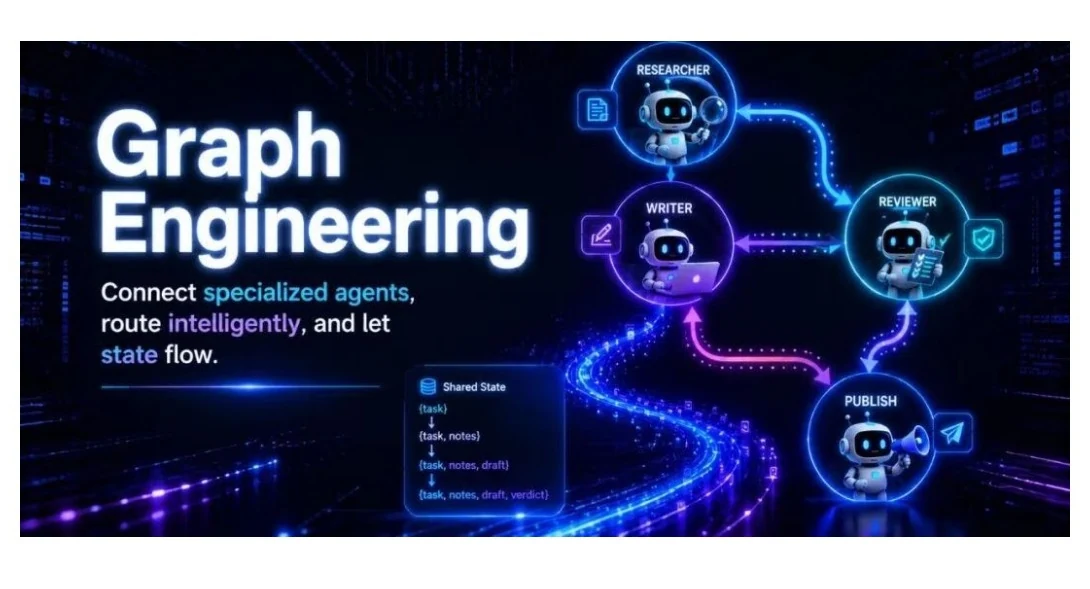
Graph Engineering means connecting multiple specialized Agents or deterministic steps into a directed graph: nodes do the work, edges handle routing, and a shared state object flows along those edges.
It serves exactly one situation: one Agent running one loop is no longer enough.
The three components are easiest to understand through the classic beginner structure of researcher, writer, and reviewer:
• A node is a unit of work. It may be a specialized Agent—the researcher gathers material, the writer drafts, and the reviewer challenges the result—or deterministic code that calls an API, queries a database, or formats output. The rule is single focus: each node does one thing.
• An edge is routing logic. Researcher to writer is a direct edge. After the reviewer scores the draft, a pass routes to publication and a failure routes back to the writer. That is a conditional edge and also a back edge.
• Shared state is the object that travels along the edges and accumulates information: {task} → {task, notes} → {task, notes, draft} → {task, notes, draft, verdict}.
What turns a collection of Agents into a system is the explicitly defined information channel between nodes. Two mainstream forms dominate today. LangGraph uses a shared state object moving along edges. AutoGen GraphFlow uses message broadcast between Agents. The forms differ, but the purpose is the same. Without the channel, you merely have three unrelated components, each speaking to its own prompt. The code below uses LangGraph’s shared-state pattern because it places “who wrote what” in the open and is therefore easiest to inspect.
If you want to run such a graph today rather than study the term, SuperClaw lets you orchestrate multiple runtimes in one workspace—it now ships as Awwo.
In code, it looks like this. The Python examples in this article target Python ≥3.10 with LangGraph 1.x, autogen-agentchat 0.7, and ADK Python 2.0. APIs may change by version; follow official documentation. The three node functions are stubs here. Their full structure appears in Article 4, and a complete runnable version is reserved for Article 6.
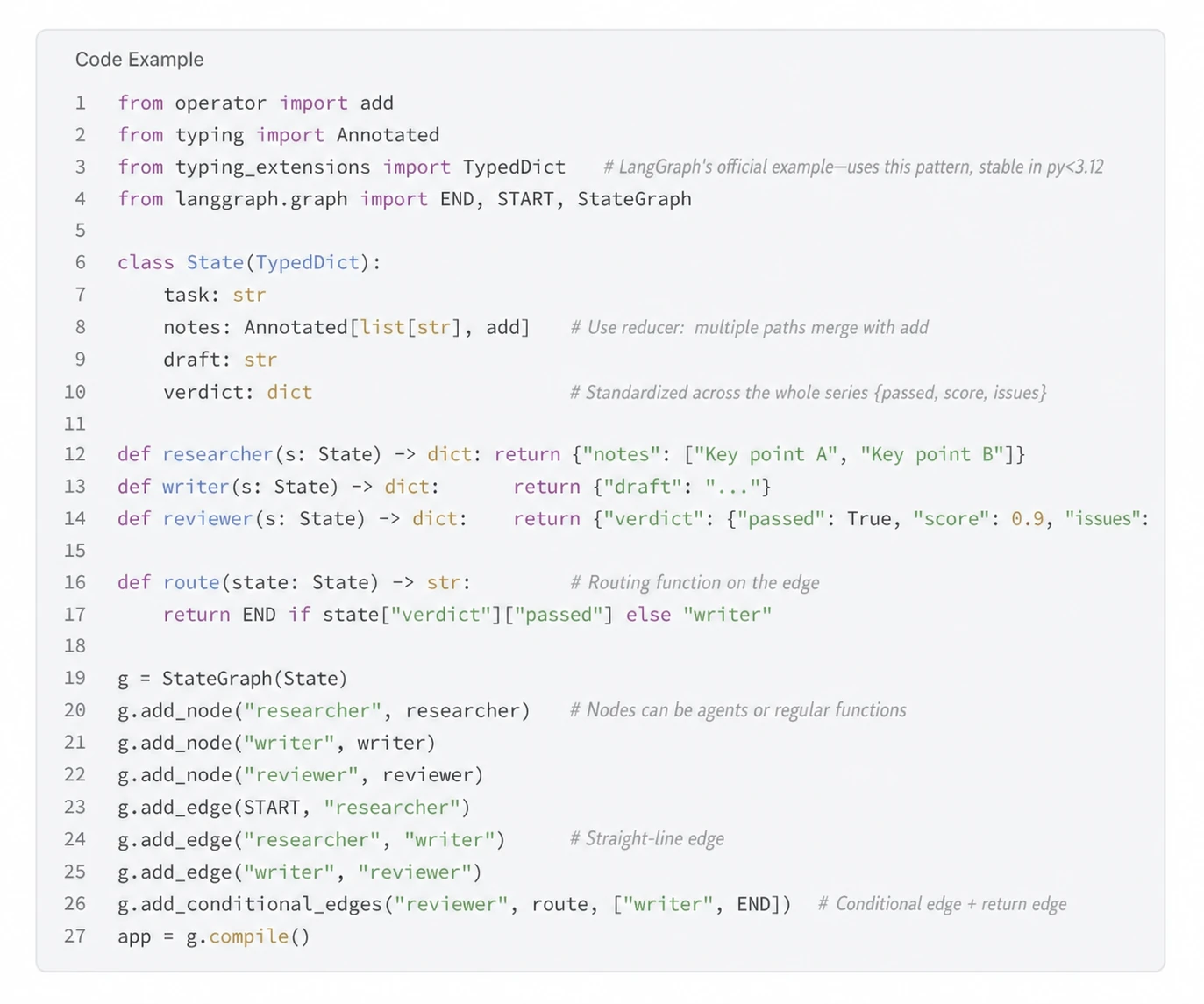
In fewer than thirty lines, the nodes, edges, shared state, and back edge are all visible. Yet the code uses LangGraph, which could run two and a half years before the term “Graph Engineering” appeared. The claim that the required runtime capabilities already existed does not rest on the shortness of the code; it rests on chronology. The next section develops that point.
One ambiguity is worth removing immediately. Topologically, a single loop can be drawn as a degenerate minimal graph: one node with an edge back to itself. But once the graph collapses to one node, two defining properties disappear at the same time—distinct nodes no longer have separate responsibilities, and routing is no longer explicitly declared. Graph Engineering as discussed here is therefore not aimed at that case. It is a layer above loop engineering, not a replacement. There is a primary source for this judgment. The official LangChain blog wrote on July 22, 2026: “Loop engineering isn't an alternative to graphs, so much as a simple version of them.”
So where is the boundary between loop and graph? The AI Builder Club guide cites a statement by @shannholmberg whose original X post I could not independently verify: the difference is who chooses the path—the Agent or you.
A loop gives path selection to the Agent. It decides which tool to call next and whether to take another turn. In a graph, you explicitly declare which paths are legal; the Agent retains runtime freedom only inside a node. This criterion works far better than counting Agents or checking whether a particular framework is present. Article 3 shows how to read it from code in five minutes.
In one sentence: a loop outsources decision-making to the model; a graph takes
part of that decision-making back.
2. First Clarification: This Is Not a Knowledge Graph and It Is Not GraphRAG
In Chinese technical communities, the word “graph” most often suggests a knowledge graph. For several years, knowledge graphs and GraphRAG have occupied nearly the entire conceptual space of “graphs” in Chinese-language discussion. If you do not share that association, you can skim this section. If you do, it will distort everything that follows and must be removed first.
A knowledge graph models data. Graph Engineering models execution. More plainly: the graph in a knowledge graph is a noun; the graph in Graph Engineering is a verb.
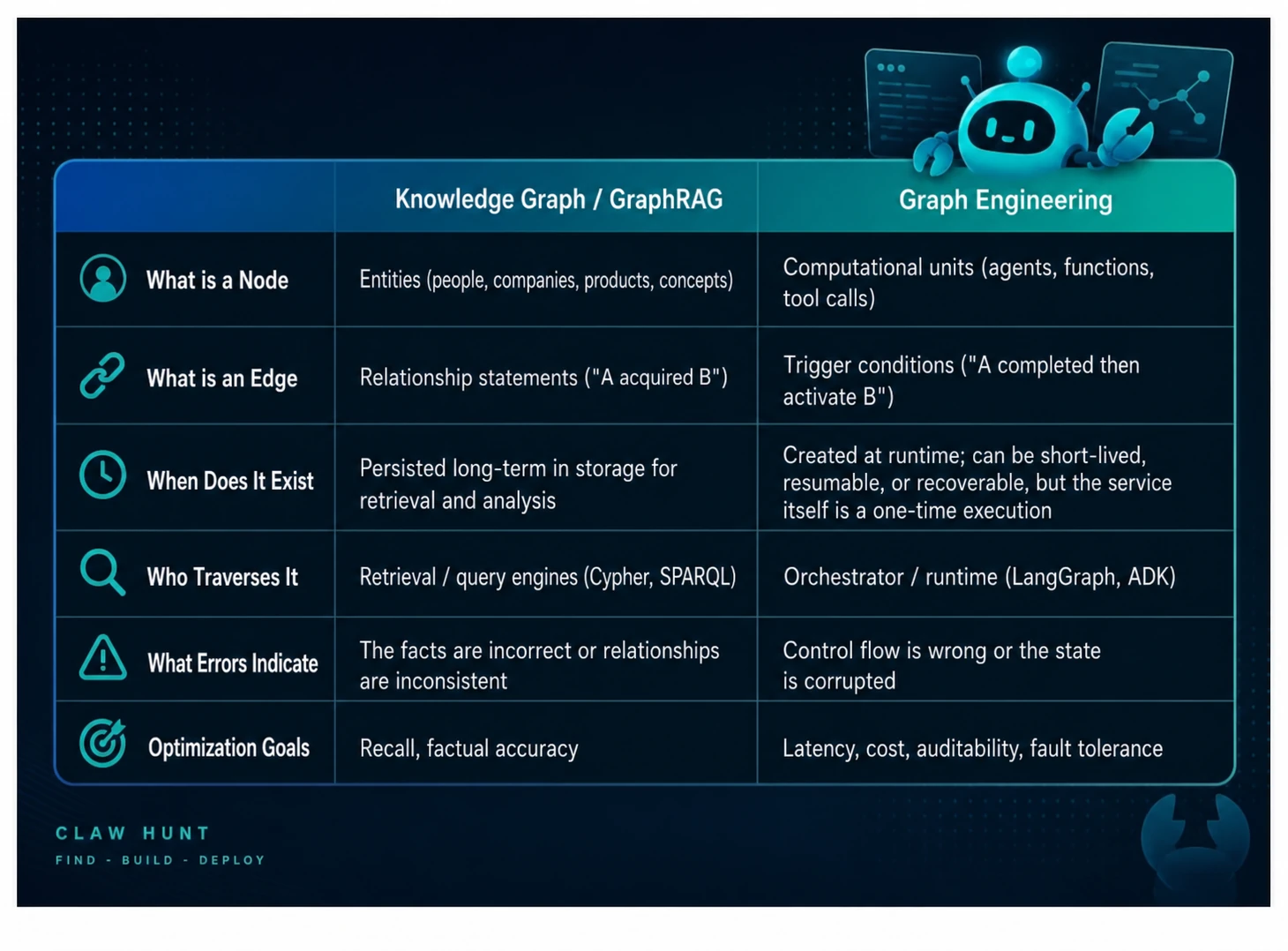
An execution graph’s state may be retained for a long time through checkpoints, including interrupt-and-resume behavior discussed later. But it exists to complete an execution, not to be queried repeatedly.
The decisive difference appears in the last two lines. Failure in a knowledge graph is epistemic: the information retrieved is wrong. Failure in Graph Engineering is operational: material that an upstream node carefully wrote into notes is silently overwritten by a downstream node, with no error and no trace, and the problem is discovered a week later in a daily report missing half its evidence.
The two ideas do not conflict and often coexist in one system. A node named “retrieval” inside an execution graph may use GraphRAG internally. That is an implementation detail inside the node. The node’s position in the execution graph, incoming-edge conditions, and writes to shared state are separate, orthogonal concerns.
If you remember only one thing from this article, remember this: the graph you query and the graph you run are not the same graph.
3. Two More Clarifications: It Is Not a New Capability, and It Is Not the Default Choice
Clarification Two: The Term Is New; the Capability Is Not
The evidence deserves to be laid out item by item because it determines how the later question about paying for Graph Engineering should be asked. Long before the term existed, many systems could already do the work:
• LangGraph, built by LangChain, centers on an abstraction literally called StateGraph. Its official positioning is a low-level orchestration framework and runtime for building, managing, and deploying long-running, stateful Agents. It predates the term by two and a half years. Even its execution model is not original: super-step scheduling descends from Google’s Pregel paper in 2010 and the earlier BSP model.
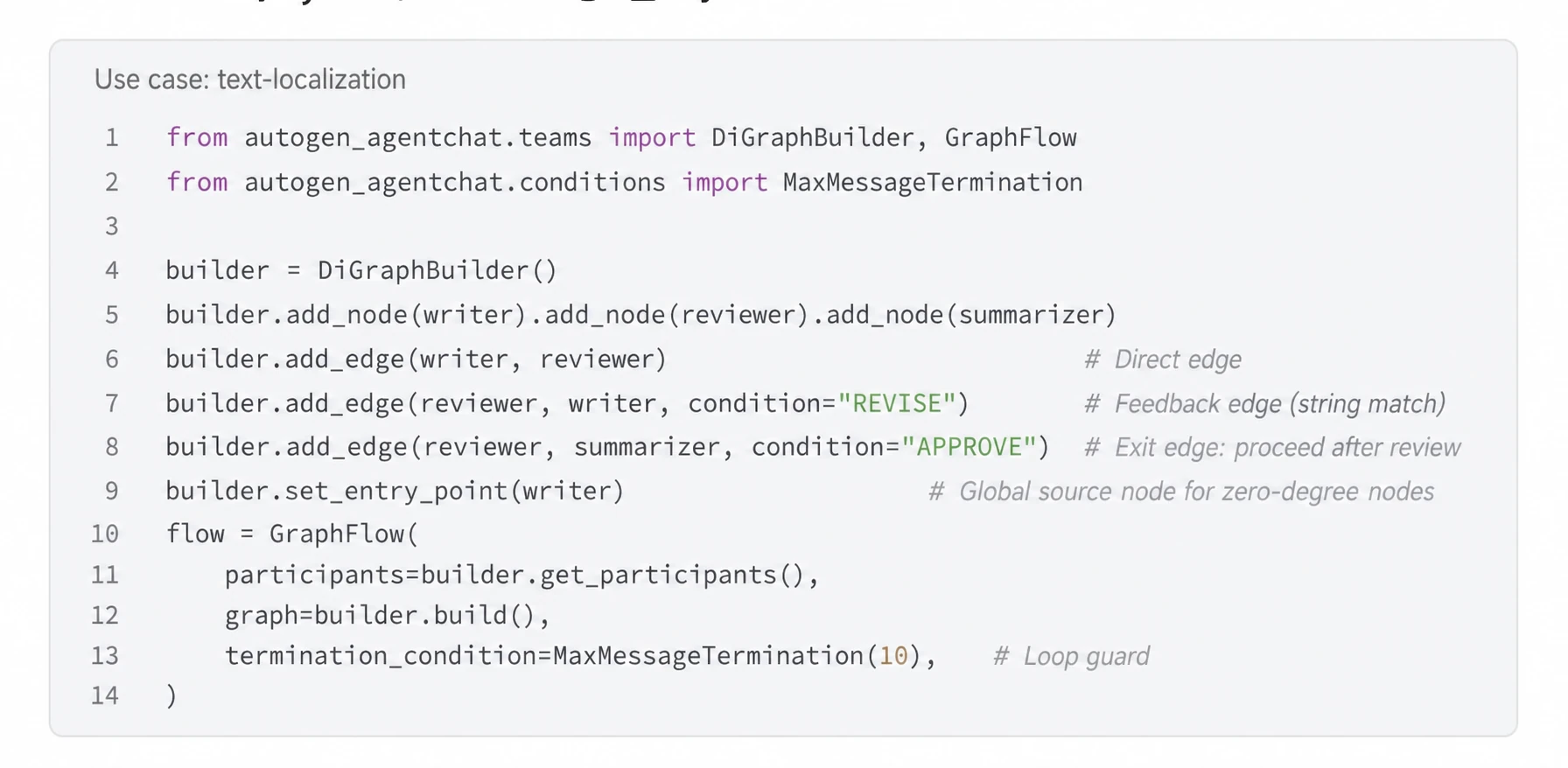
• Microsoft AutoGen GraphFlow: DiGraphBuilder adds nodes and edges and supports conditional edges, fan-out, fan-in, and loops with exits. It also predates July 2026.
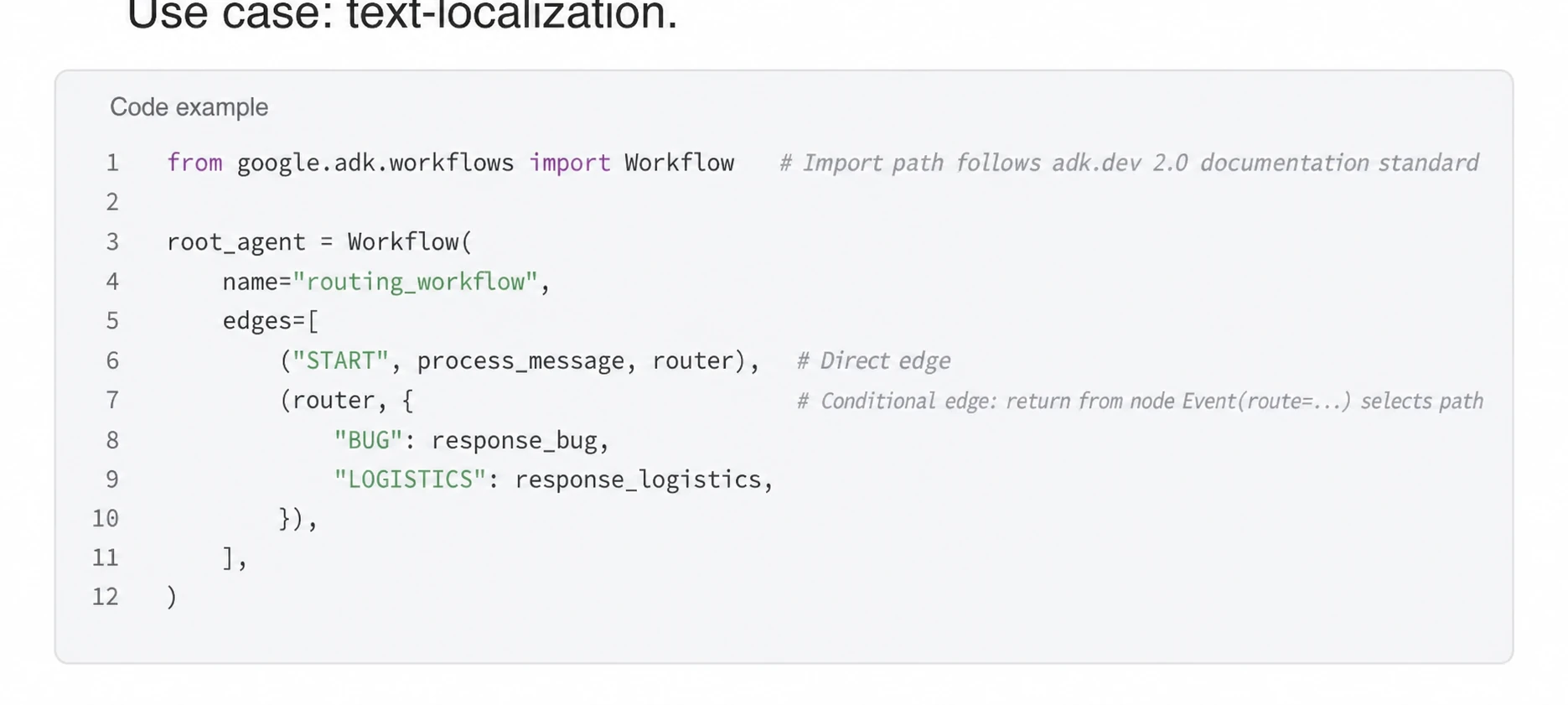
• Google ADK 2.0 replaced its hierarchical Agent executor with a graph engine. Agents, Tools, and Functions all become graph nodes. Python 2.0 reached GA on May 19, 2026, and Go 2.0 on June 30, 2026. The official documentation declares it as shown above.
• A2A, or Agent2Agent, is an open protocol through which Agents delegate and collaborate as peers. Its most valuable use case crosses trust boundaries, although the protocol does not require an organizational boundary and is equally useful across internal teams and deployment units. Google released it on April 9, 2025, donated it to the Linux Foundation on June 23, 2025, and released v1.0 in March 2026. At least on the standardization timeline, enterprises acted more than a year before the announcement wave on X. I have no primary data on the scale of actual adoption; that question is deferred to Articles 7 and 10. A common confusion is worth removing now: A2A connects Agent to Agent, while MCP—the Model Context Protocol released by Anthropic in November 2024—connects an Agent to tools and data sources. They occupy different layers and are not competitors. Article 7 expands on the distinction.
One layer further back, none of these underlying ideas is original. Airflow offered DAG orchestration in 2014. Temporal provides durable execution. State machines include XState, Petri nets, and decades of automata theory. Node isolation and supervision trees come from Erlang/OTP’s actor model. Directed graphs and state machines are old furniture in computer science, not inventions of 2026.
What happened around July 18–19 was naming, not launching.
This chronology also corrects the question about payment. To decide whether the term deserves your money, do not ask whether it is new. Ask whether the seller is providing runtime capability or decomposition judgment. The runtime capability is already free in the systems listed above, so paying merely for that capability makes no sense. Whether decomposition judgment deserves payment can only be evaluated after Section 5 draws the boundary between the engineering skill and the framework.
Clarification Three: It Is Not the Default; It Introduces Distributed-Systems-Level Complexity
“Distributed-systems-level complexity” is a conclusion that needs evidence. Here are four examples from real framework documentation and issues:
1. Concurrent Write Conflicts
When two parallel nodes write to shared state at the same time, which one wins? LangGraph’s answer is that you must declare a reducer for the field, such as the Annotated[list[str], add] shown earlier. Without one, two outcomes are possible. Parallel writes raise InvalidUpdateError immediately; sequential writes are silently overwritten by the next node, with no error and no trace. The second kind is much harder to diagnose. Article 6 explains why the runtime requires an explicit declaration.
2. Fan-In Semantics
When three edges point to one node, should it activate only after all three arrive or as soon as any one arrives? AutoGen provides activation_group and activation_condition, with values such as “all” and “any,” so you can express mixed conditions such as “A and B both arrive, or C arrives alone.” A single loop never forces you to answer this question.
3. Dead Ends and False Matches
The moment you introduce conditional edges, you also own two new classes of error: a dead end when no outgoing condition is satisfied, and a false match when a criterion is based on free text. The discipline can be summarized in one sentence: conditional-edge criteria should read only structured fields, and outgoing routes must always include a fallback. Article 4 provides the causes and code.
4. Idempotency on Resume
After LangGraph’s interrupt() suspends and resumes, the node reruns from the beginning. Any side effect before the interruption—sending email, charging money, writing to a database—happens again. Official guidance is to move side effects after interrupt(), isolate them in independent nodes, or use idempotent writes such as upsert. Google ADK has a hard prohibition on directly changing session.state retrieved from SessionService outside the lifecycle. Its documentation warns that this bypasses event tracking and creates race conditions and lost updates.
These four costs do not arrive as one bundle the moment you “use a graph.” They accumulate according to topology. Add parallel branches and you take ownership of concurrency control and activation semantics. Add conditional edges and you take ownership of dead-end analysis. Add human-in-the-loop interruption and you take ownership of idempotent recovery. The opening researcher → writer → reviewer graph is serial with one back edge. It has no parallel writes, no multi-input fan-in, and no suspension point, so it encounters only the third of the four problems. “Graphs introduce distributed-systems complexity” must therefore be discounted according to the actual topology rather than used as a blanket warning.
There is also a cost issue that receives little attention: fan-out amplifies the cost of loop defects. This does not mean parallel execution is inherently more expensive than serial work—the same five tasks consume five sets of tokens either way. What is unique to parallel execution is late discovery and a higher peak. Article 9 quantifies the multiplier with formulas and cost tables.
The decision rule should therefore be conservative. Here is the conclusion in advance: if several nodes can collapse into one Agent loop without losing any of four properties—parallelism, context isolation, enforcement and auditability, or independently retryable and suspendable positions—then they should collapse back into one loop. The complete criterion appears in Article 5. “Summarize this PDF” is exactly that kind of case. It does not need a five-node graph for fetch → chunk → summarize → review → format. That structure merely bakes in overhead without unlocking anything a single loop cannot do.
The operational side of standing those nodes up is covered in our guide to deploying Kimi K3 open weights locally.
4. How a Term Crystallized in Two or Three Days
The timeline is short. The term was repeatedly used and amplified on X around July 18–19, 2026, followed by responses and backlash around July 20. Again, every person and statement in this section is cited second-hand from the source note at the beginning. Read it as a story, not evidence. MarkTechPost’s July 29, 2026 review explicitly says the term’s provenance remains unresolved.
The trigger was a question. Peter Steinberger, author of OpenClaw, asked whether “we are still talking about loops or have already moved to graphs,” and @sairahul1 relayed it into a larger circle. It was a question, not a declaration. Some secondary reports turned it into “the era of loop engineering has ended,” which is a distortion.
@rohit4verse supplied the framing. He offered the analogy repeated by later articles: Agents are graduating from while loops into organizational charts, where specialized nodes run in parallel and state flows between them. @Vaibhavsisinty called it a quiet transition. @svpino declared, “Loop Engineering is dead; long live Graph Engineering.”
The analogy works not because it is exact—an organizational chart is a tree, while an Agent graph is a directed graph that may contain cycles—but because it changes the reference frame. With “while loop” in your head, you instinctively ask, “What happens this turn, and when do we exit?” Replace it with “organizational chart” and the questions become: Who owns what? That is the node’s single focus. Who reports to whom? Those are edge directions and conditions. Where does failure go? Those are fallback edges and fault isolation. This second set contains the real design problems of a multi-Agent system. But the analogy expires after the reference frame changes. Push it into hierarchy or accountability and it becomes misleading: an Agent graph is cyclic and has no single superior.
The backlash arrived just as quickly. @RhysSullivan, @DavidKPiano, @PawelHuryn, and @NathanFlurry each offered a criticism; Article 10 addresses them one by one. Only one matters directly here: @NathanFlurry complained that the Graph Engineering posts failed to mention A2A at all. He was right, as the A2A timeline above demonstrates.
Following that disagreement, I recommend separating the term from the transition and reducing the judgment to two lines:
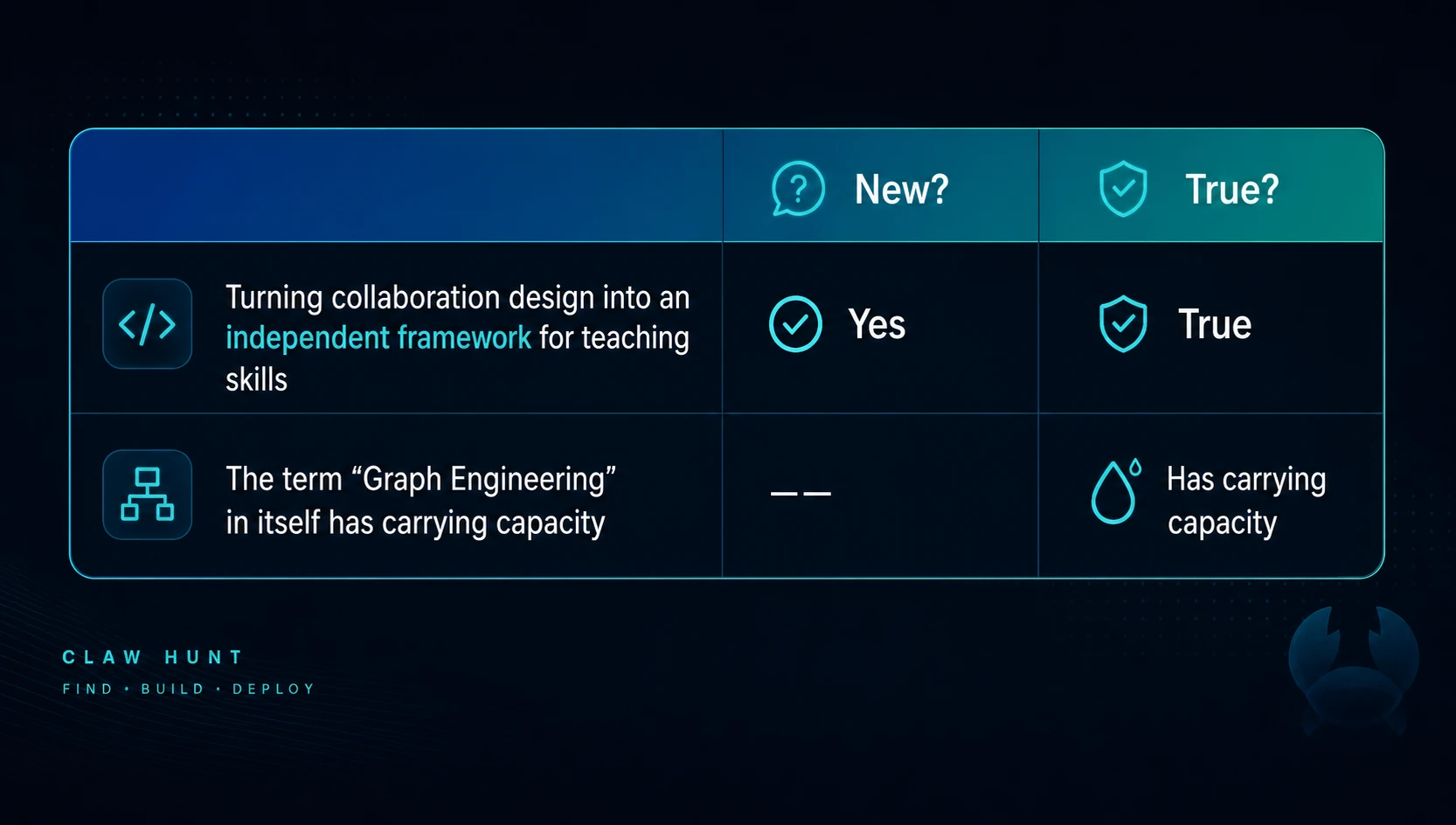
Those two lines are my filter. Positioning Graph Engineering as a framework-independent skill is new and worth learning. The term itself contains hype and is not worth paying for. Collaboration design was never new. What is new is pulling it out of the “tips for using this framework” section of individual documentation and treating it as a transferable engineering craft. That distinction is the destination of the next section.
5. The Person Who Stood to Benefit Most Publicly Expressed Doubt
The suspense in this series comes from the least expected person.
Harrison Chase is co-founder and CEO of LangChain, and LangGraph comes from him and his team. In theory, he should have benefited most from the wave: everyone suddenly adopted a new term for what his framework had been doing for more than two years.
Yet his response on X on July 20 was skeptical. In essence, he said he did not really understand what Graph Engineering meant and still did not; it sounded mostly like LangGraph. This post is also cited through the AI Builder Club guide. I could not independently verify the original X post, so the date and wording follow that secondary compilation. The next turn is revealing. Two days later, on July 22, 2026, the official LangChain blog published 3 Years of Graph Engineering with LangGraph. The stance shifted from doubt to: the term is a buzzword, but buzzwords appear for a reason, and we have been doing this for three years. LangGraph’s first public release was in January 2024, making it two and a half years old in July 2026. “Three years” counts earlier internal work according to LangChain’s own convention; that extra half-year is itself part of the act of claiming the narrative. Another detail should not be overlooked: the article is credited to Sydney Runkle and Harrison Chase. The person claiming the term is the same person who reportedly said two days earlier that he did not know what it was.
Only two days separate personal doubt from official ownership, but that does not prove technical value. The simplest explanation is a commercial reflex to claim narrative ownership, the same move as the gold rush on X but performed more elegantly. It proves only that once a term becomes a coordinate system, even the person most qualified to say “we were already doing this” must accept that coordinate system in order to be heard. That is a fact about communication, not technology.
Harrison’s statement is a useful starting question for the entire series because it is simultaneously correct and incomplete.
The correct part is easy to verify. Technically, every capability Graph Engineering requires exists in LangGraph, AutoGen, ADK, and in a sense Temporal. Only the vocabulary and teaching frame are new, not the runtime.
The incomplete part is that a framework gives you capabilities but does not make decisions for you.
LangGraph forces you to write a state schema, but it does not tell you what belongs in that state, who can write each field, or which fields need reducers. ADK gives you parallel primitives, but it does not tell you whether three research branches should run in parallel or how a join node should synthesize conflicting conclusions. AutoGen gives you conditional edges, but it does not remind you to create a fallback edge.
A framework determines whether something can be done. Graph Engineering must answer whether it should be done, how to decompose it, and how many pieces to create. Those decisions used to be scattered through framework documentation as product-specific usage techniques. Now they have been extracted into a framework-independent engineering skill. That is the new row in the table from the previous section—and the term’s only genuine contribution.
Whether the idea can sustain ten articles will be answered by the next nine.
6. Series Map
1. This Article—What Is Graph Engineering? An Old Idea That Only Got a Name in July 2026
2. From Prompts to Graphs: The Five-Layer Stack of AI Engineering—and Which Layer You Are On. The layers accumulate rather than replace one another; skip the lower layers and a graph only fails more elegantly. 3. Loop or Graph? There Is Really One Criterion: Who Decides the Path, and How to Read It from Code. 4. Anatomy of an Agent Graph: Nodes, Edges, and Shared State—the Design Decisions and Common Mistakes, Including Four Edge Forms and State-Object Design. 5. When Should You Use a Graph? Six Signals and One Collapse Test—with Anti-Patterns; the Default Answer Is “You Do Not Need a Graph.” 6. LangGraph in Practice: Running the Researcher → Writer → Reviewer Graph for Real—Reducers, Send Fan-Out, Checkpoints, and Human Approval. 7. Three Other Paths: AutoGen GraphFlow, Google ADK, and the A2A Protocol—Framework Comparison and What Happens When an Edge Crosses the Company Boundary. 8. The Reviewer Node: The Most Valuable Node in the Entire Graph—Why the Node That Produces Nothing Is Worth the Most. 9. Four Production Traps: State Drift, Fault Isolation, Cost Loss of Control, and Invisible Execution. 10. Controversy and Endgame: Is This Term Another Wave of Garbage Content? Plus Your Starting Checklist.
The remaining articles in this ten-part series will be added to the ClawHunt articles index as they ship.
Key Takeaways
• Graph Engineering means nodes doing work, edges routing, and shared state flowing along edges. Use it only when one Agent running one loop is insufficient.
• It is unrelated to knowledge graphs and GraphRAG. Those model data; this models execution. A knowledge graph’s graph is a noun, while Graph Engineering’s graph is a verb. The graph you query and the graph you run are not the same graph.
• The capabilities already existed in LangGraph, AutoGen GraphFlow, ADK 2.0, A2A, and before them Airflow, state machines, and actor models. July 18–19, 2026 brought naming, not a launch. Also distinguish A2A, which connects Agent to Agent, from MCP, which connects Agents to tools and data. They are complementary layers, not competitors.
• The costs of a graph are real but accumulate according to topology. Parallelism creates concurrent-write conflicts and fan-in activation semantics. Conditional edges create dead ends and substring false matches. Interruptions create resume-idempotency obligations. Fan-out also amplifies defect cost through late discovery and higher peaks. If the design fails the collapse test, collapse it back into one loop. The full criterion appears in Article 5.
• According to AI Builder Club, Harrison Chase himself doubted the term. Two days later, the official LangChain blog—a verifiable primary source co-authored by Chase—claimed it. He was right that the runtime is not new. What his statement missed is that a framework never makes decomposition decisions for you.
Next: Article 2—From Prompts to Graphs: The Five-Layer Stack of AI Engineering—and Which Layer You Are On
To follow updates to the series and learn more, follow the official account or visit clawhunt.store.
If you need this kind of frontier-tech survey produced on demand, you can hire research agents on the marketplace.
References and Sources
Shirley, Graph Engineering Guide (2026), AI Builder Club, published July 20, 2026 and updated July 27. Every statement from X and the July 18–20 timeline in this article is cited through this source.
https://www.aibuilderclub.com/blog/graph-engineering-guide-2026
LangChain, “3 Years of Graph Engineering with LangGraph,” Sydney Runkle and Harrison Chase, July 22, 2026. https://www.langchain.com/blog/3-years-of-graph-engineering-with-langgraph
Asif Razzad, “Prompt Engineering vs Loop Engineering vs Graph Engineering,” MarkTechPost, July 29, 2026. The article notes that the provenance of the term remains unresolved.
https://www.marktechpost.com/2026/07/29/prompt-engineering-vs-loop-engineering-vs-graph-engineering/
Official LangGraph documentation—StateGraph, reducers, interrupt/resume, and idempotency: https://docs.langchain.com/oss/python/langgraph/overview and https://docs.langchain.com/oss/python/langgraph/interrupts
LangGraph error page for INVALID_CONCURRENT_GRAPH_UPDATE, where parallel writes to a key without a reducer raise InvalidUpdateError:
https://docs.langchain.com/oss/python/langgraph/errors
AutoGen GraphFlow user guide—DiGraphBuilder, activation_group, activation_condition, substring matching on conditional edges, and the experimental notice: https://microsoft.github.io/autogen/stable//user-guide/agentchat-user-guide/graph-flow.html
AutoGen issue #6551, “GraphFlow fails to find next speaker when conditional edge is added”: https://github.com/microsoft/autogen/issues/6551
AutoGen to Microsoft Agent Framework migration guide—Workflow vs. GraphFlow: https://learn.microsoft.com/en-us/agent-framework/migration-guide/from-autogen/
Google ADK 2.0 overview and release dates: https://adk.dev/2.0/; graph workflows: https://adk.dev/graphs/; Sessions/State: https://adk.dev/sessions/state/
A2A protocol specification and v1.0 announcement from March 2026: https://a2a-protocol.org/latest/specification/ and https://a2a-protocol.org/latest/announcing-1.0/
Model Context Protocol specification: https://modelcontextprotocol.io/
Malewicz et al., “Pregel: A System for Large-Scale Graph Processing,” SIGMOD 2010.